
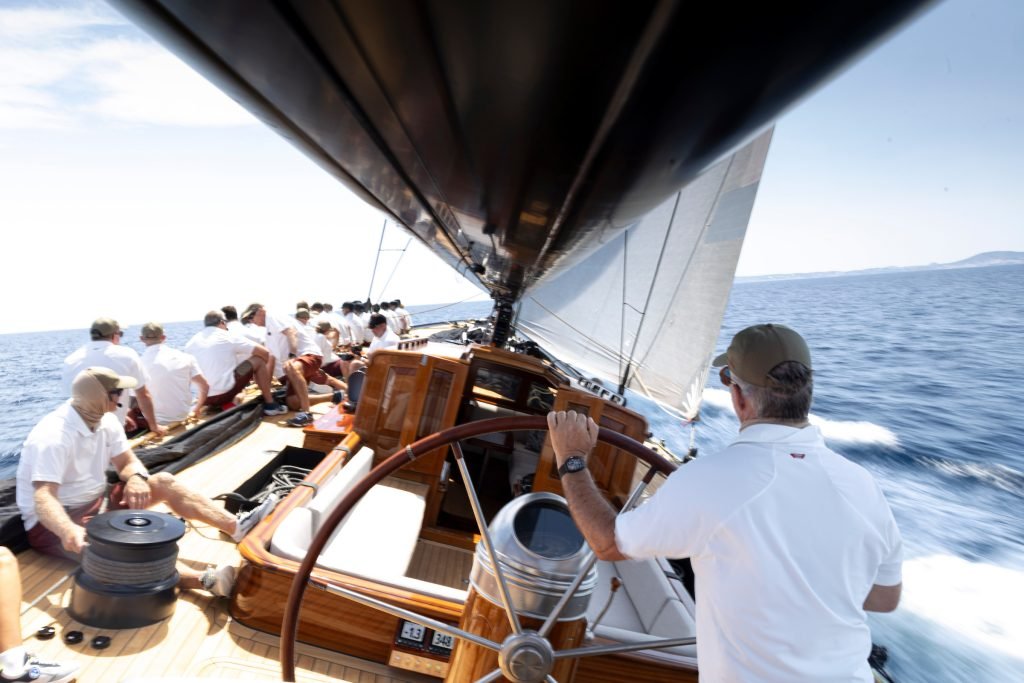
Between 1930 and 1937, a handful of extremely wealthy men commissioned a handful of extremely large sailing boats in order to race each other for a silver ewer. The rule they were built to – the Universal Rule’s J class — produced yachts of roughly forty metres with masts approaching fifty-five, enormous overhangs, and proportions that a century of naval architecture has not improved upon.
Ten were built. The era lasted seven years. Most were scrapped for their metal during the Second World War.
Three survived: Shamrock V, launched in 1930 for Sir Thomas Lipton’s final America’s Cup challenge; Velsheda, built in 1933; and Endeavour, Tom Sopwith’s 1934 challenger and, by most reckonings, the most beautiful yacht ever drawn.
Raising the Dead
What happened next has no real parallel in any other field of collecting. Beginning in the early 2000s, owners started building new J Class yachts from original 1930s drawings, including designs that had been drawn, submitted, and never constructed.
Ranger came in 2002, a recreation of Harold Vanderbilt’s 1937 defender. Hanuman followed in 2009, built to the lines of Endeavour II. Lionheart, Rainbow and Topaz arrived over the next few years. Then Svea; designed by Tore Holm in Sweden in 1937, never built, and finally launched some eight decades later at 43,6 metres, the largest of the class.
The fleet now stands at nine. That is the largest number of J Class yachts in existence at any point in history, including the 1930s.
The construction is not replica work in the pejorative sense. The hulls are aluminium, the masts carbon fibre, the winch systems modern. But the lines are the originals, unaltered, because the original lines were correct. There is something faintly astonishing about a 1937 hull form being competitive with anything, and about a design office in 2026 concluding that the right move is to build exactly what Tore Holm drew.
The 2026 Return
The difficulty with the J Class has never been the boats. It is that owning one and racing one are different propositions. A J requires a professional crew of around thirty, a support programme, and a season’s commitment. Many owners cruise instead, and the fleet has spent recent years scattered across the Mediterranean and the Caribbean rather than lining up against each other.
2025 was one of those quiet years. 2026 is not. Rainbow has been bought by Peter Harrison, an Admiral’s Cup winner, and will be raced by his Jolt Sailing Team. Louise Morton has returned to lead the J Class Association for a third term. Svea comes back to racing after a cruising year on the American East Coast and in the Caribbean. Shamrock V, the oldest of them all, has completed a 4.500-nautical-mile shakedown cruise following her refit and is planning an active season.
The calendar centres on two events: the Palma Superyacht Regatta in June, and Les Voiles de Saint-Tropez from 26 September to 4 October, where Rainbow and Svea are confirmed. For anyone in the western Mediterranean at the end of this month, that is the appointment.


© J Class Association
What They Represent
The modern superyacht conversation runs almost entirely on capability – ice-class hulls and transoceanic range, hybrid propulsion, autonomy measured in weeks. It is genuinely impressive engineering, and it is the correct direction for a industry that has spent a decade justifying itself.
The J Class argues for something else entirely. These yachts are impractical by any measure: enormous crews, punishing running costs, uncomfortable accommodation, no purpose beyond going round a course faster than the boat next to you. They exist because somebody looked at a nine-decade-old drawing and decided the world was poorer without it.
There are signs the argument is being heard. Lürssen’s recent return to classical proportion in Boardwalk suggests a market quietly tiring of the architectural avant-garde, and the same instinct will be visible on the docks at the Monaco Yacht Show this month. But nothing built today will look, under sail, like a J.
Featured photo: © J Class Association