
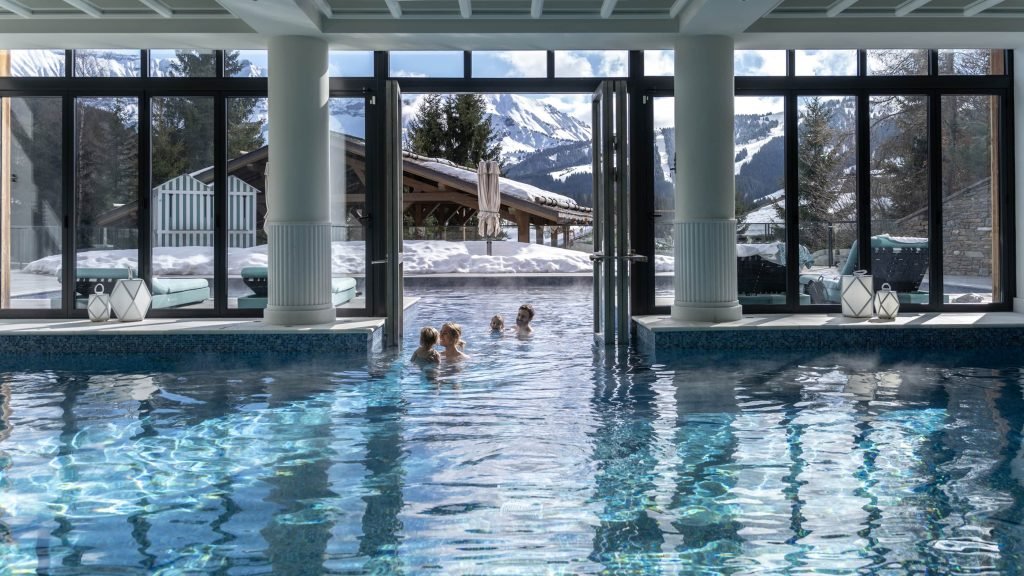
Five stars is the ceiling of the hotel classification system in almost every country that has one. In France, it is the entry requirement for something else.
The Palace distinction was created in 2010 by the French state, awarded by the Ministry responsible for tourism on the recommendation of Atout France and an independent Palace Commission. It is not a fourth or fifth star. It sits above the star system entirely, and it is granted for three years at a time, after which a hotel must submit itself for reassessment and can, in principle, lose it. What was merely theoretical until this year became real on 2 June 2026.
The 2026 Collection
Atout France announced thirty-three Palaces for the next three years. Twenty-seven had their distinction renewed and six received it for the first time: Bvlgari Hotel Paris, Cheval Blanc Paris and Fouquet’s Paris in the capital, Four Seasons Resort Megève in the Alps, Hôtel Martinez in Cannes, and Royal Champagne Hôtel & Spa, the first Palace the Champagne region has ever held.

Bvlgari Hotel Paris © Lartisien Hotel Collection
The more consequential news was the subtraction. Following the first full reassessment of the programme in seven years, four houses lost the title, among them Park Hyatt Paris-Vendôme, which had been among the very first hotels distinguished when the label was created, alongside Hôtel du Palais in Biarritz, Byblos in Saint-Tropez and Mandarin Oriental Paris. Some departures reflect renovation; others, plainly, reflect a judgement about service.
That is what makes the label useful. A distinction nobody can lose is a marketing device. A distinction that can be withdrawn from a Parisian institution after fifteen years is an actual standard.
What Is Actually Being Judged
The five-star classification is a grid – several hundred measurable criteria covering room dimensions, facilities, languages spoken, accessibility, environmental practice. A hotel can be built to satisfy it. The Palace assessment is deliberately not that. The commission examines location, the history and character of the building, the personalisation of service, the quality of the table, the wellness offer, aesthetic coherence, environmental commitment and international standing.
In other words, it measures the things that cannot be installed. A new-build can be five stars within a year of opening. It cannot easily manufacture the sense that a house has been receiving guests properly for a century.
Geographically, the 2026 collection tells its own story. Paris holds thirteen, still the centre of gravity. The Alps count seven, led by Courchevel. The Riviera and south-east hold nine, from Saint-Tropez to Antibes. The south-west keeps two, the overseas territories one, and Champagne joins for the first time.

Royal Champagne Hotel & Spa © Lartisien Hotel Collection
How It Compares?
The Palace is a national instrument, and that is both its limitation and its strength. It covers only France, so it cannot rank a house against a peer in Kyoto or Milan. But because the state administers it, it is not subject to the commercial pressures that make some international rankings difficult to read, and it has teeth that most of them lack.
It also measures something different from the newer hotel guides. When Michelin finally began grading hotels, its Key system set out to reward sense of place and value as much as grandeur — a deliberately international, deliberately subjective instrument. The Palace is narrower and, in its way, more demanding: it asks whether a house embodies the French art of living, which is not a criterion any hotel can satisfy by spending money.
For the traveller, the practical use is simple. Every hotel in France that calls itself exceptional is five-star. Thirty-three of them have had that claim examined by a commission with the power to say no — and, as of this June, the demonstrated willingness to say it. A plaque that can be taken away is worth considerably more than one that cannot.
It is also worth remembering what sits behind the plaque. The distinction rests overwhelmingly on service, and service at this level still runs on individuals rather than systems — which is why the concierge with crossed golden keys on the lapel remains the most valuable and least understood person in a great hotel. Grand buildings can be bought. That cannot.
Featured photo: © Four Seasons Resort Megève