
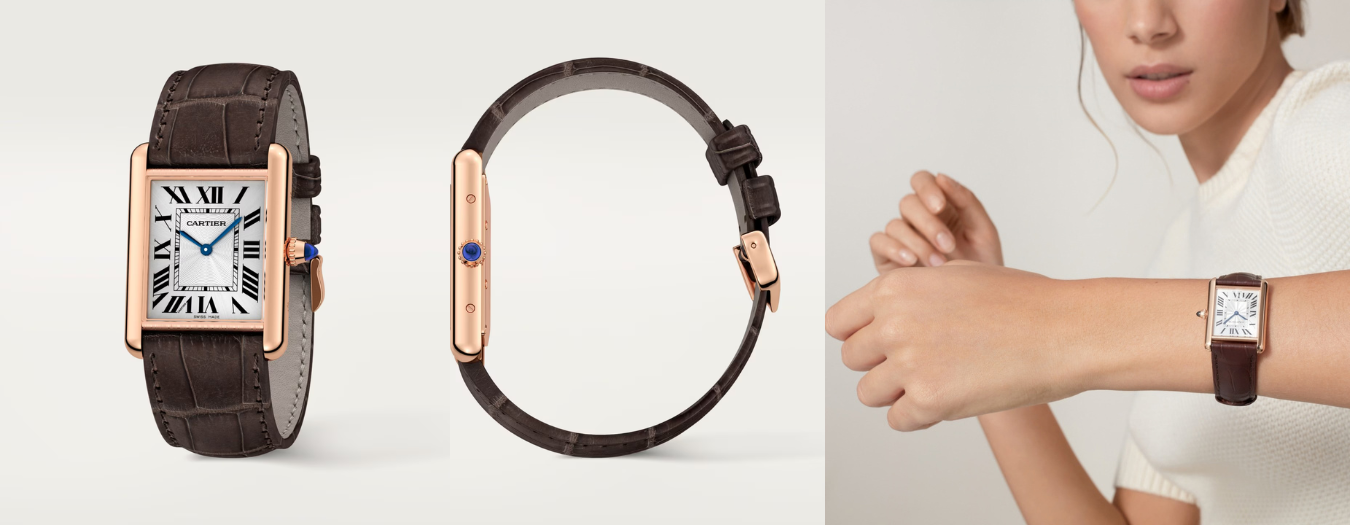
Most mechanical watch movements are built around wheels, and the round watch case follows that logic naturally. It is an efficient shape for the machinery inside. In 1917, Louis Cartier chose a rectangle.
A Watch Built Around Proportion
The Tank took its inspiration from the military tanks of the First World War. Cartier describes the design as a view of a tank from above: the case represents the vehicle’s cabin, while the two parallel brancards running along its sides evoke the tracks. Louis Cartier translated that reference through a jeweller’s understanding of line and proportion, at a time when the wristwatch itself was still developing into the object we recognise today.
The brancards extend directly into the strap, creating an uninterrupted line through the case. Roman numerals, blued sword-shaped hands and the railway-track minute chapter became part of a visual language that remains immediately recognisable. The Tank was created in 1917, and Cartier presented the first prototype to General John Pershing before bringing the watch to market in 1919.
More than a century later, the basic geometry remains intact. It arrived remarkably early in the history of the modern wristwatch and has required remarkably little reinvention to remain relevant.
One Shape, Many Tanks
The watch most people now associate with the name is the Tank Louis Cartier, introduced in 1922, originally as the Tank à Bords Arrondis. Its softer, rounded brancards refined the original geometry and eventually became one of the defining expressions of the design.
The Tank developed into an entire family. The Tank Cintrée, introduced in 1921, stretched and curved the case to follow the wrist. The Tank Américaine elongated the silhouette vertically, while the Tank Française, introduced in 1996, integrated the Tank into a metal bracelet. The Must de Cartier era brought the design to a much broader audience from the late 1970s, and the Tank Must remains one of the most accessible ways into the collection today.

Tank Cintrée watch © Cartier
Then there is the Tank à Guichets. First created in 1928, it abandoned the conventional dial almost entirely. A solid metal face was interrupted by two apertures, one for the jumping hour and another for the minutes. Nearly a century before digital displays became ordinary, Cartier had created a mechanical watch that presented time as numbers rather than hands moving around a dial.
Early examples are exceptionally rare. Cartier returned to the idea only occasionally, including anniversary pieces in the 1990s and a Collection Privée Cartier Paris edition in 2005.
In 2025, the Tank à Guichets returned through Cartier Privé. The case measures 37.6 by 24.8 mm and only 6 mm thick. The crown returned to 12 o’clock, echoing the earliest 1928 examples, while the new manually wound calibre 9755 MC powers the jumping-hour and dragging-minute display. Cartier introduced yellow-gold, rose-gold and platinum versions alongside a more radical platinum interpretation limited to 200 pieces. Almost a century after the original, one of the strangest Tanks was back in the Cartier collection.

Tank à Guichets watch © Cartier
Why the Rectangle Endures
The Tank has survived several generations of watches that seemed better suited to their moment. Purpose-built dive watches transformed what people expected from a wristwatch in the mid-20th century. The integrated-bracelet steel sports watch changed luxury collecting again after Gérald Genta’s Royal Oak appeared in 1972. More recently, the market’s fascination with tool-watch heritage and waiting lists has made specifications, scarcity and performance part of the conversation around luxury watches.
The Tank has followed a different path. Even contemporary Tank Louis Cartier models are relatively simple watches. Many display only hours and minutes, with thin cases and modest water resistance. Their appeal has never depended primarily on technical performance. The proportions do most of the work.
That places the Tank in the small company of watches, alongside Bvlgari’s Serpenti, that belong as comfortably to the history of design and jewellery as they do to watchmaking.
Its owners have made that argument for generations. Jackie Kennedy wore one. So did Yves Saint Laurent, Duke Ellington and Andy Warhol. Warhol famously owned a Tank despite reportedly admitting that he did not wear it to tell the time.
More than a century after Louis Cartier drew that first rectangle, the Tank remains remarkably close to the original idea. Its longevity has depended less on reinvention than on the strength of the proportions established at the beginning.
Featured photo: © Cartier