
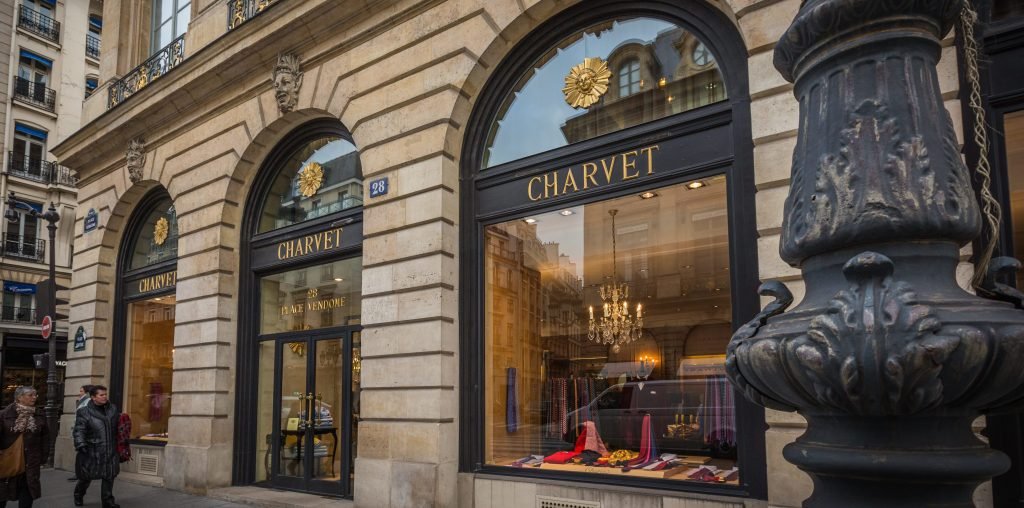
Before 1838, a gentleman who wanted a shirt went to a tailor, or to his wife, or to a seamstress. There was no such thing as a shop that sold shirts and nothing else, for the same reason there was no shop selling only buttons.
Joseph-Christophe Charvet, whose father had served as keeper of Napoleon’s wardrobe, opened one on the rue de Richelieu in Paris. He took measurements at the front and had the shirts cut and sewn at the back. The French language had no word for what he was, so one was coined: chemisier.
By 1839, he held the title of official shirtmaker to the Jockey Club, then the most exclusive circle in Paris and the natural habitat of the Parisian dandy. The house moved to 28 Place Vendôme in the 1870s and has been there since.

© Charvet Place Vendôme
Visit Charvet official website
What Charvet Actually Does
The building is seven floors, and it is the entire business. There are no boutiques elsewhere; a small ready-to-wear selection reaches a handful of international retailers, but the house’s core has always been what happens inside that address.
The bespoke process is unhurried to a degree that now feels almost provocative. Measurements are taken in detail, a trial shirt is made, adjustments are recorded, and only then is the final garment cut. The archive of a client’s pattern is kept indefinitely. What distinguishes the house, though, is choice: Charvet is known for holding several thousand fabrics in stock, across a range of colours and weaves that no competitor attempts, on the principle that the customer should not be edited before he has chosen.
The neckties made the name travel furthest. Charvet’s silks were so distinctive that charvet entered the language as a generic term for a particular type of tie silk; one of the very few instances of a luxury house’s name becoming a fabric.
The Clientele as Documentation
The customer list is unusual less for its grandeur than for its span. Baudelaire and Proust. The Duke of Windsor. Winston Churchill. Charles de Gaulle. John F. Kennedy. Gabrielle Chanel herself. Writers used the name so often as shorthand for a character’s taste that it functions as a period marker in French and English literature alike.
Nearly two centuries of continuous patronage across aristocrats, artists and heads of state is a peculiar kind of asset. It cannot be created, and until this summer, it had never been sold.
The Chanel Question
In July 2026, Chanel announced it had acquired Charvet, including the Place Vendôme headquarters, ending 188 years of independent family ownership. Terms were not disclosed.
The deal follows a collaboration: Chanel’s new artistic director, Matthieu Blazy, worked with the house on his debut collection, producing a women’s shirt made to Charvet’s standards. Chanel’s president of fashion activities framed the acquisition as a responsibility to support and perpetuate rare artisanal skills, and the group has said Charvet will retain its creative independence.

Charvet shirt at the Chanel SS27 show © Isidore Montag / Gorunway.com
There is reason to take that seriously. Chanel has spent years acquiring the specialist ateliers that supply French luxury: embroiderers, feather-workers, glovemakers, shoemakers – precisely because those skills die when the last workshop closes, and no amount of capital revives them afterwards. It is a preservation strategy before it is a commercial one.
There is also reason for caution. Independence is what allowed Charvet to move at its own pace, to hold thousands of fabrics that turn slowly, to decline growth. Ownership by a group with global ambitions changes the incentives, however carefully the intentions are stated. The best outcome is that nothing visible changes for a very long time.
Which would be entirely in character. Charvet has survived the collapse of the aristocracy that first sustained it, two world wars, the disappearance of the detachable collar, and the near-death of the formal shirt itself – the arc that runs through every argument about restraint in menswear and every reversal since, up to and including the maximalism now taking its place.
Through all of it, the proposition has not moved: come to Place Vendôme, be measured properly, choose from more cloth than you expected, and wait. It is the same offer Savile Row makes for a jacket, made for the garment underneath it, and made first.
Featured photo: © mosaic.gr