
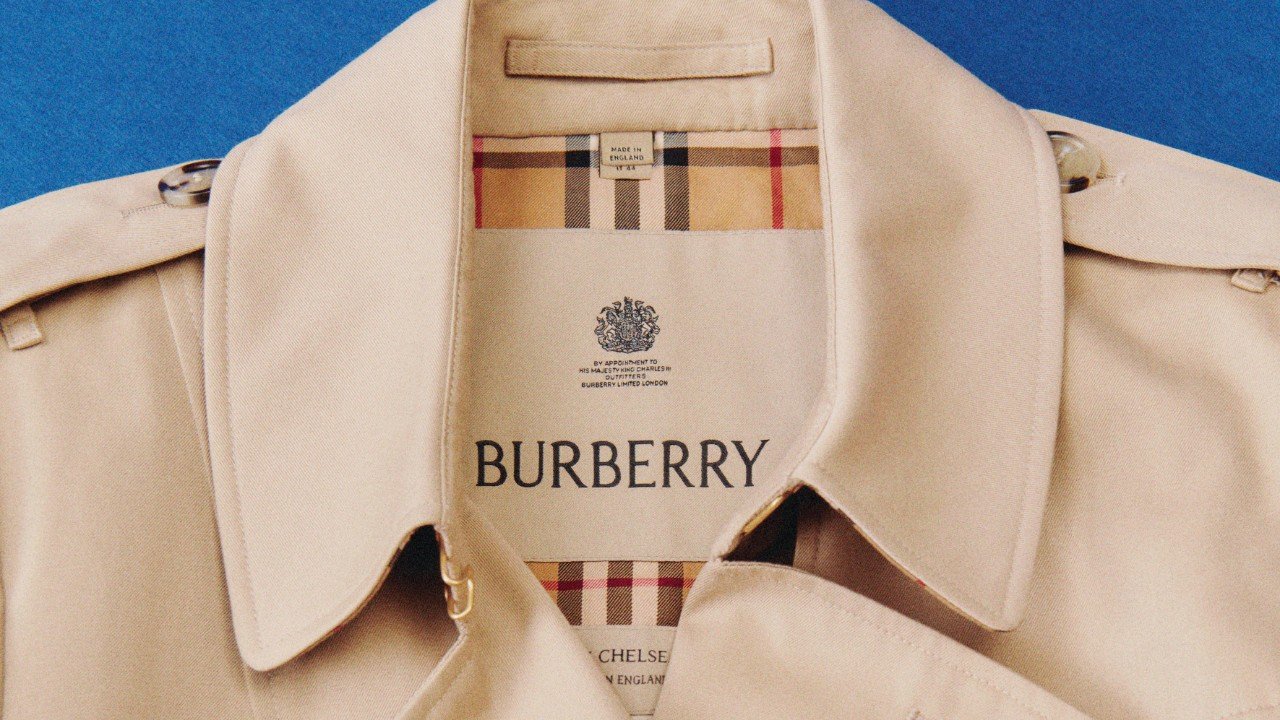
Most clothes are designed for a season. The Burberry trench coat was designed for a war, and it has outlasted everything since. This month, the Victoria and Albert Museum opens a display tracing how a piece of military kit became one of the most enduring garments in the history of fashion, a coat that looks essentially the same today as it did a century ago, and is worn for essentially the same reasons.

© Burberry
The story begins not with a coat but with a cloth. In 1879, Thomas Burberry, a draper who had opened his business in Basingstoke in 1856, invented gabardine: a tightly woven cotton that was breathable and water-resistant, unlike the heavy rubberised and waxed raincoats of the day. He is said to have taken the idea from the lanolin-coated smocks worn by Hampshire shepherds, and the invention was revolutionary enough that Ernest Shackleton wore Burberry gabardine to Antarctica in 1907.
What came next was a coat called the Tielocken, the trench’s direct predecessor, with a belt and broad lapels. When the First World War began, Burberry adapted it for the officers fighting in the trenches, and every element that now reads as a style detail started as a solution to a problem. The epaulettes displayed rank. The D-rings on the belt carried equipment. The storm flap kept the rain off, the deep pockets held maps, the gun flap sat where it was needed. British soldiers named it after the place they wore it, and the trench coat had its name.


© Burberry
How a Military Coat Became a Wardrobe
When the war ended, demobilised officers brought the coat home, into the towns and cities, and it quietly shed its military associations while keeping its shape. What sealed its place was cinema. Humphrey Bogart wore one in Casablanca. Audrey Hepburn wore one in the rain at the end of Breakfast at Tiffany’s. From there it attached itself to every archetype that needed a certain kind of authority or mystery: the detective, the spy, the reporter, and later the science-fiction hero, from Blade Runner to The Matrix.
This is the part that makes the trench genuinely unusual. Very few garments survive a hundred years with their form intact, because fashion is built on change, on the seasonal replacement of one silhouette with another. The trench never had to change, because it worked the first time.

Breakfast at Tiffany’s (1961) © IMDb
Still Made the Same Way
That quality is also why it remains expensive to do properly. Burberry still manufactures its heritage trench coats in Castleford, Yorkshire, and still weaves the gabardine at its mill in Keighley. The collar alone is made up of eight parts and can require up to 270 stitches to achieve the fluid curve that lets it sit correctly on the neck. It takes a maker up to a year simply to learn how to stitch it. It is the same principle behind everything we have written about the pieces worth investing in this season: what lasts is rarely what costs the least.

© Burberry
Why It Belongs in a Museum, and on the Street
The V&A display, which opens on 21 September and runs free in the Prince Consort Gallery, gathers pieces that show the coat’s range: a womenswear catalogue from the late 1930s and 40s, a mirror-embroidered version from 2015, a baroque-print fringed trench from 2025, even a personalised Burberry car coat once owned by the designer Hardy Amies. What the collection shows is not how much the trench has changed, but how little it has needed to.
Burberry marks its 170th anniversary this year, and the timing suits the coat. Autumn is trench season, the moment it returns to city streets without anyone deciding it should. It never left, and it was never really a trend, which is exactly why it is still here.
Featured photo: © Burberry