
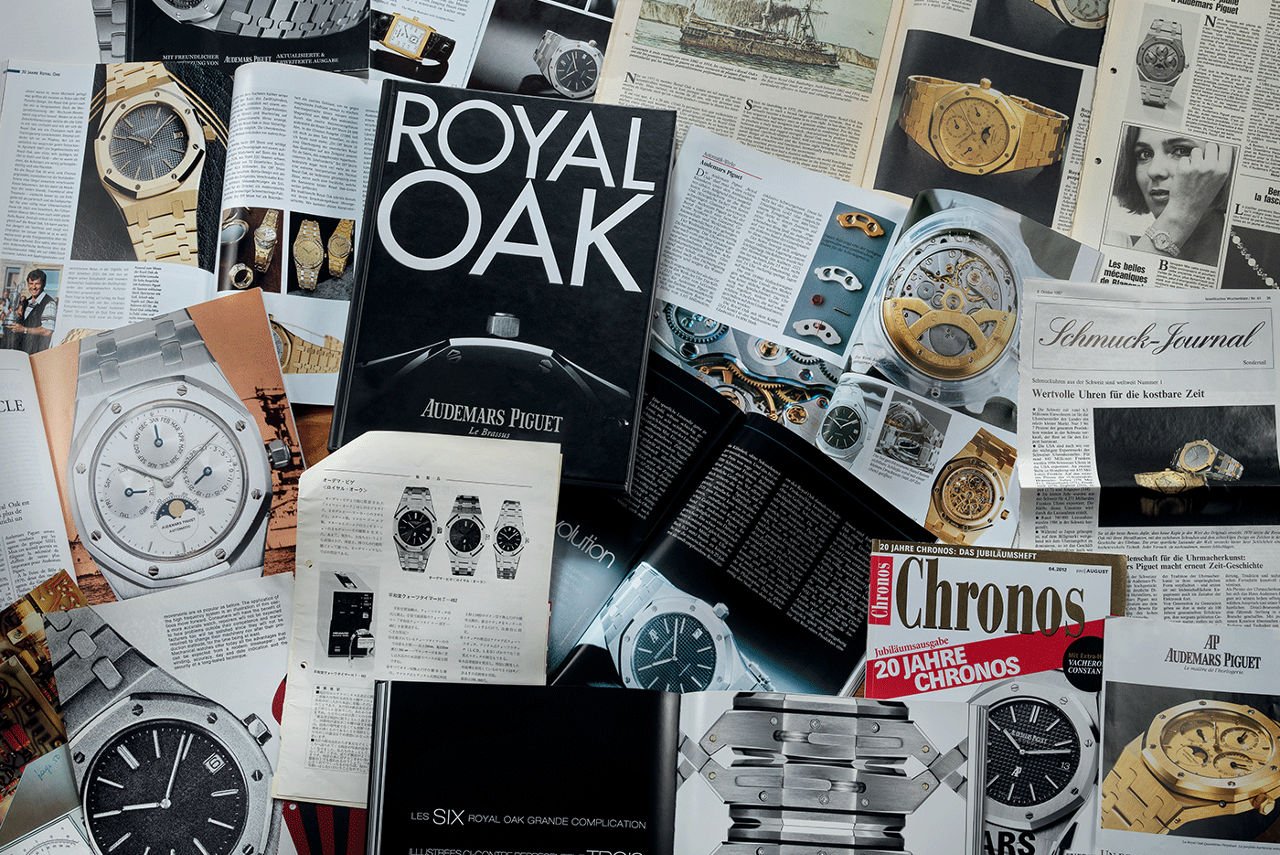
The story has been told so often it has acquired the smoothness of myth: Audemars Piguet, facing the collapse of mechanical watchmaking under quartz, asks Gérald Genta for something new. Genta draws it overnight. The result is presented at Basel in 1972 — a steel watch, in an octagonal case, with visible screws, priced above the gold watches sitting beside it.
The trade thought it was a mistake. It took years to sell through the first series. Half a century later, every luxury house in Switzerland has an integrated-bracelet steel sports watch in its catalogue, and almost all of them are answering an argument that Genta made first.
What the Sketch Actually Proposed?
The Royal Oak’s genius is not the octagon. It is the proposition that finishing, not material, determines value. Steel was, in 1972, the metal of tool watches — the cheap stuff, the thing you made a diver from. Genta’s insistence was that a steel case subjected to the same hand-finishing as a gold one, with the same alternation of satin brushing and mirror-polished chamfers meeting at crisp, hand-drawn angles, would be worth more than gold treated casually. This was not a marketing claim. It was a workshop claim, and it was correct.
The octagonal bezel, its eight hexagonal screws, and the tapering integrated bracelet that flows from case to clasp without an obvious seam all exist to serve that argument. The bracelet in particular remains among the hardest objects in watchmaking to execute well — every link individually finished, the taper unbroken, the whole thing required to fall over the wrist like fabric. It is where the hours go, and where the imitations fail. The Petite Tapisserie dial — that grid of tiny raised squares, cut on a hundred-year-old pantograph — completes the thesis. It is decoration achieved by machining, not by applying anything. Nothing is added to the watch to make it precious. It is precious because of what was removed with precision.

Where It Stands in 2026?
Fresh from its 150th anniversary, Audemars Piguet has spent this year pushing the collection somewhere genuinely interesting: openwork.
The centrepiece is Calibre 7139, a skeletonised evolution of the Calibre 7138 perpetual calendar introduced for the anniversary. The 7138’s achievement was usability — it consolidated the calendar functions onto a single plane, kept the movement remarkably thin, and routed every adjustment through the crown, doing away with the recessed pushers and the little corrective stylus that have irritated perpetual calendar owners for decades. The 7139 takes that architecture and opens it up, material removed by electrical discharge machining, the remaining bridges satin-brushed and chamfered by hand, the whole visible through a sapphire dial. It debuts across a 41mm Royal Oak and a Code 11.59.
Alongside it sit two tone-on-tone openworked studies: a 39mm Royal Oak “Jumbo” Extra-Thin in titanium and bulk metallic glass — an amorphous alloy, more than half palladium, that behaves structurally like glass — and a 37mm Double Balance Wheel Openworked forged entirely in yellow gold. Read together, these are not a house chasing novelty. They are a house demonstrating that the original argument still has room in it: that the value is in the surfaces, and that you can keep removing material as long as what remains is finished beautifully.
The Uncomfortable Part
The Royal Oak’s problem in 2026 is the same as Patek’s with the Nautilus and Rolex’s with the Submariner — the watch that was too expensive to sell in 1972 is now too scarce to buy. Allocation, waiting lists, relationships. Genta drew an object meant to be worn; the market has made it something to be obtained. That is not the watch’s fault, and it does not diminish the sketch. Fifty-four years on, the octagon is still the shape everyone else is drawing around. For the other half of the Genta story, see our account of Patek Philippe’s Nautilus at fifty.
Photos: © Audemars Piguet