
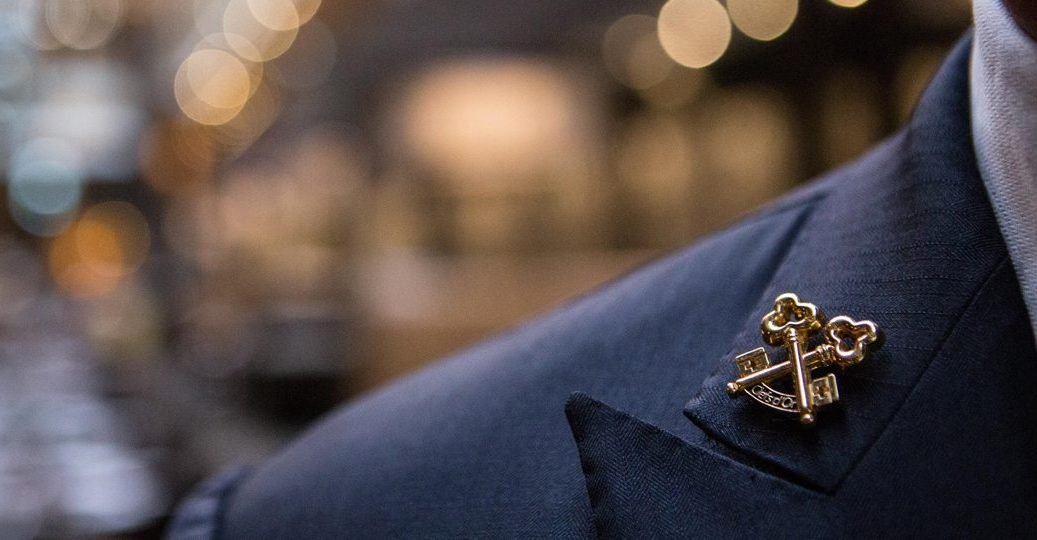
There is a small pair of crossed golden keys worn on the lapel, and most guests who pass the desk never notice them. Those who do, and who understand what they mean, tend to approach the desk differently thereafter. The insignia belongs to Les Clefs d’Or, and the story of how it came to exist is considerably more human than the mystique surrounding it suggests.
Eleven men and a dinner
On 26 October 1929, Pierre Quentin, concierge at the Hôtel Ambassador in Paris, sent invitations to twenty colleagues across the city’s grand hotels, proposing dinner at Restaurant Noël Peters in the Passage des Princes, across the road from his own front door. Eleven came.
The proposition was simple and slightly radical: that concierges working at competing hotels might be more useful to their guests as a network than as rivals. A guest arriving in a strange city needs a table, a car, a ticket, a doctor, a florist at nine on a Sunday evening. One concierge knows his own quarter. Twenty know a city. Two hundred know a continent.
Within four weeks the association was ratified at a General Assembly attended by more than seventy-five members. Quentin was elected its first president. Swedish and Dutch chapters followed, many of them formed during the Depression as much for mutual support through unemployment and illness as for professional advancement. Then the war closed everything. The Paris hotels were occupied; the association went dormant.
Cannes, 1952
What revived it was one man’s persistence. Ferdinand Gillet, Swiss-born and by then chef concierge at the Hôtel Scribe in Paris, spent the post-war years travelling Europe to find other concierges and persuade them that the idea still worked. On 25 April 1952, delegates gathered at the Carlton Hotel in Cannes for the first multinational congress. France, Italy, Switzerland, Germany, Great Britain and Ireland at the table, with Belgium and Denmark observing and Spain invited.
The Union Européenne des Portiers des Grands Hôtels was born that day, and the industry has called Gillet the father of Les Clefs d’Or ever since. His formulation of the job has never been improved upon: to serve without being a servant. The organisation went international in 1970 and was formally renamed in 1998 as the Union Internationale des Concierges d’Hôtels, a deliberate shift from porter to concierge. The same restructuring brought the association its first female president, Marjorie Silverman of the American section. Today it counts roughly four thousand members across some forty-five national sections, headquartered at 12 rue Cambon in Paris. The motto remains what it has always been: in service through friendship.

The First International Congress (1952) © Les Clefs d’Or
What the keys actually buy you
The romance of the thing (Wes Anderson borrowed it wholesale for the Society of the Crossed Keys in The Grand Budapest Hotel) obscures a genuinely practical mechanism. A Clefs d’Or concierge in Zagreb has a counterpart in Kyoto, and the call between them carries an obligation that no booking platform can replicate. Members are not permitted to accept membership casually; sections require years of hotel-floor experience and sponsorship by existing members.

The Grand Budapest Hotel (2014) © IMDb
What that produces is a form of knowledge that cannot be indexed. Which table at which restaurant, and why the one by the window is a mistake in August. Which driver will wait without being asked. Which gallery will open an hour early for someone who is asked properly. This is the same infrastructure that has quietly underwritten the hotel’s transformation into a destination in its own right, the dining rooms get the attention, but the desk makes the stay.
Ninety-six years after eleven men had dinner in the Passage des Princes, the proposition holds. The most valuable thing in a great hotel is rarely the marble. It is the person behind the desk, and the several thousand people they can telephone on your behalf. Read the official history of Les Clefs d’Or
Featured photo: © Les Clefs d’Or