
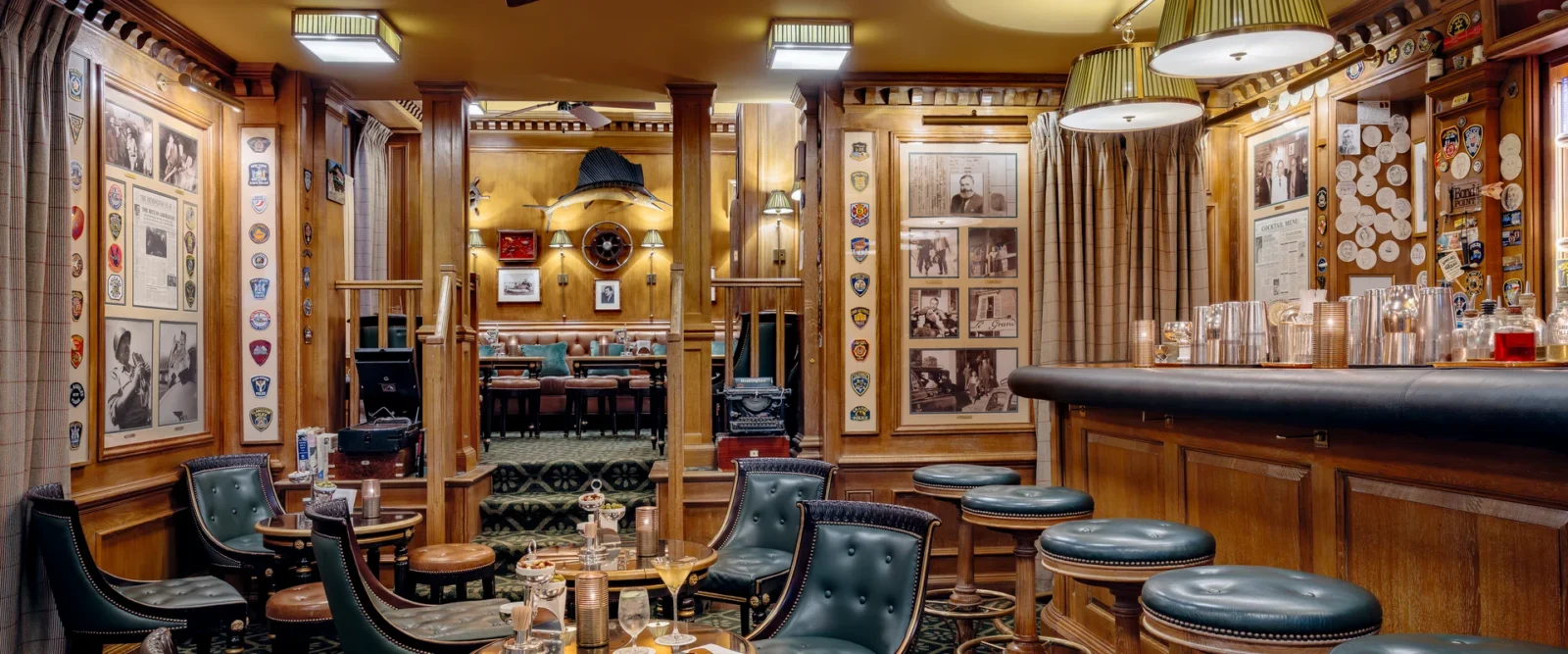
Every element of a great hotel can be replaced. The restaurant can be handed to a new chef, the lobby restyled, the rooms stripped to brick and rebuilt to a fresh brief. Owners do all of this routinely, and guests barely register it.
The bar is the exception. Announce that the bar is being reimagined and you will hear from people who have not stayed in the hotel for a decade.
Why the Bar Is Different
A hotel restaurant is a destination. You book it, you dress for it, you have an opinion about it afterwards. A hotel bar is a room you end up in: after dinner, before a flight, when a meeting finishes early, when it is raining. It is the only space in the building with no occasion attached, and that is exactly why it becomes the room people remember.
It is also the only room where the hotel’s guests and the city’s residents meet as equals. The great bars have always had a local constituency: journalists, lawyers, actors, people who work nearby and drink there weekly without ever taking a room upstairs. This matters more than it sounds. A hotel whose bar is full only of its own guests has, in a quiet sense, failed to join its city.
The Institutions
Bar Hemingway at the Ritz Paris is the obvious example, and the mythology around it, from Hemingway’s claimed liberation of the hotel in 1944 to the framed photographs and the room’s improbable smallness, has if anything obscured how well it is actually run. Colin Field’s long tenure behind the bar turned it into the most awarded room of its kind in the world, and the achievement was not the cocktails. It was that a room built entirely on legend somehow avoided becoming a museum of itself.


Bar Hemingway © Ritz Paris
The American Bar at the Savoy makes the case differently. Its claim rests on documentation rather than anecdote: Harry Craddock’s Savoy Cocktail Book, published in 1930, remains one of the founding texts of the discipline, and the room has been serving continuously since the 1890s. Ada Coleman, who presided before Craddock and invented the Hanky Panky, was one of the first women to run a bar of international standing anywhere.
Then there are the rooms that carry no legend at all and work anyway: the small, low-lit bar off a lobby somewhere in Milan or Vienna where the barman remembers what you drank in March. That is the whole discipline reduced to its essential.
What Cannot Be Installed
The current fashion is for the hotel bar as spectacle: rooftop, view, list of forty signature serves, a design story. Some of these are excellent. Almost none of them are institutions, and the reason is instructive.
An institution requires continuity of staff. The value of a great bar is held in the memory of the people behind it: who you are, what you drink, whether you want company tonight. That knowledge is accumulated slowly and lost instantly. A group that rotates bar staff on a two-year cycle can build a beautiful room and never build a bar. It is the same asset that makes a career concierge irreplaceable, and it is equally invisible on a balance sheet.
This is also why the bar tends to survive renovations that reshape everything around it. Owners who would cheerfully gut a restaurant think twice about the bar, because they understand, sometimes only after making the mistake once, that they are not renovating a room. They are interrupting a relationship.
The most interesting test of all this is now arriving in London, where the storied house at 94 Piccadilly reopens as Cambridge House after 134 years as a private club. A new bar in a building with an enormous social history, and no continuity of staff to inherit. Whether it becomes an institution or merely a very good room is something no amount of investment can decide. Only time can, and time is the one thing hospitality cannot buy — which is precisely the quality that the newest hotel gradings are trying, imperfectly, to measure.
The old test still holds. Sit at the bar alone, without a phone, and see how long it takes before the room makes that feel entirely normal. In the great ones, it is immediate.