
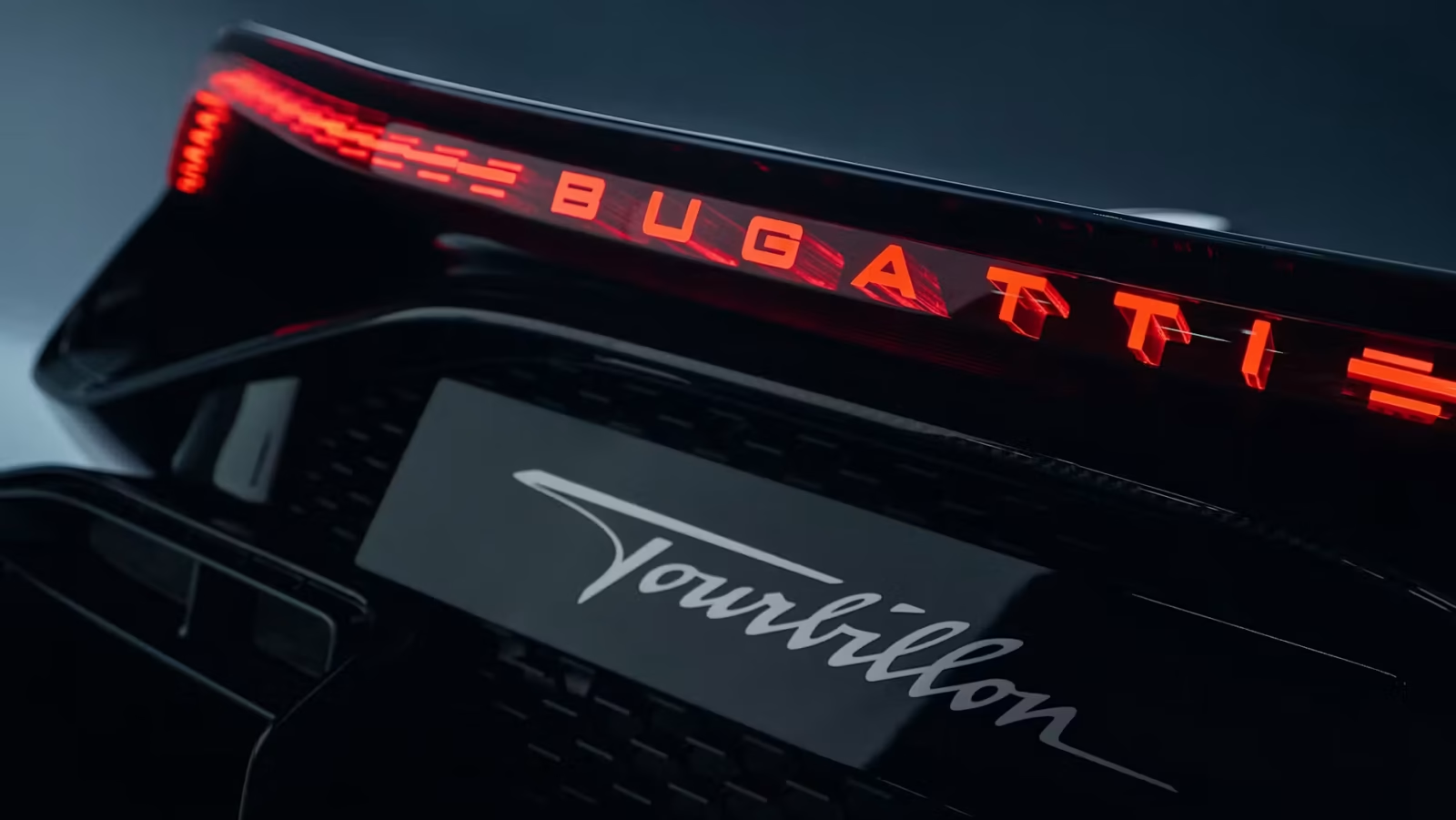
For two decades, every Bugatti has been defined by one component. The 8.0-litre quad-turbocharged W16, introduced in the Veyron in 2005 and carried through the Chiron and the Mistral, was among the most extraordinary engines ever put into a road car: sixteen cylinders arranged in two narrow-angle banks, four turbochargers, and enough thermal output to require ten radiators.
The Tourbillon replaces it with something almost defiantly old-fashioned. Sixteen cylinders again, but in a conventional 90-degree V, displacing 8.3 litres, with no forced induction whatsoever.
This was not a compromise forced by regulation. It was a decision about character.

© Bugatti
What a Turbocharger Costs?
Forced induction is the most efficient route to power that exists, which is why nearly every performance engine now uses it. But it changes what an engine feels like. A turbocharger sits between the combustion event and the exhaust note, muffling it. It flattens the torque curve, so peak output arrives early and stays. Enormously effective, certainly, but slightly inert. It also caps engine speed, because there is little reason to rev an engine that has already delivered everything it has by 6,000rpm.

Remove the turbochargers and all three reverse. The engine breathes directly, so the sound is unfiltered. Torque builds progressively rather than arriving in a slab. And the engine wants to rev. The Tourbillon’s V16 runs to 9,000rpm, which for a road-car engine of this displacement is close to absurd.
Bugatti’s stated reasoning was that the experience should be more emotional. That may sound like marketing language, but there is a real engineering position behind it. The Chiron was already faster than any owner could reasonably use, so the next car did not need to chase numbers. It needed to be more involving.
The Cosworth Problem
Building a naturally aspirated V16 that meets modern emissions standards is genuinely difficult, and Bugatti did not attempt it alone. The engine was developed with Cosworth, the British firm behind the DFV that dominated Formula One for a generation and, more recently, the 12,100rpm V12 in the Gordon Murray T.50.
Cosworth went from initial sketches to a running engine on the dynamometer in thirteen months. The finished unit weighs around 252 kilograms, remarkable for an 8.3-litre sixteen-cylinder, and uses a crossplane crank and dry-sump lubrication.
On its own, the V16 produces 1,000 metric horsepower. Three electric motors, two on the front axle and one at the rear, contribute a further 800, for a combined 1,800 PS. A 24.8kWh battery gives roughly 60 kilometres of electric range under WLTP, and the whole assembly drives all four wheels through an eight-speed dual-clutch gearbox with torque vectoring.


The Instrument Panel Nobody Expected
The car’s name is not a driver’s, unlike Chiron or Veyron. A tourbillon is a watchmaking device, and the reference is literal. The Tourbillon’s central instrument cluster is a Swiss-made mechanical assembly of more than six hundred components, built by watchmakers, with titanium and sapphire in place of the screens that dominate almost every other modern cabin.
It is a genuinely radical decision. Screens age badly. A decade-old infotainment interface can make a car feel older than almost anything else inside it. A mechanical instrument does not date in quite the same way because it was never designed around the technology of a particular moment. It is the same logic behind the return of coachbuilding at Rolls-Royce. At the very top of the market, craftsmanship and permanence can matter more than another line on the specification sheet.
Two hundred and fifty Tourbillons will be built at Molsheim, with deliveries beginning late this year. Bugatti quotes two seconds to 100km/h and a top speed, with the Speed Key engaged, of 445km/h.
Those figures matter less than the choice behind them. The industry is moving toward silence, and doing it beautifully, as the Rolls-Royce Spectre demonstrates, where absolute quiet turns out to be perhaps the most Rolls-Royce quality imaginable.
Bugatti has hybridised too. But it has spent that engineering budget preserving something electrification cannot reproduce, and something the great grand tourers have always understood: an engine that sounds like it is enjoying itself.
Featured photo: © Bugatti