
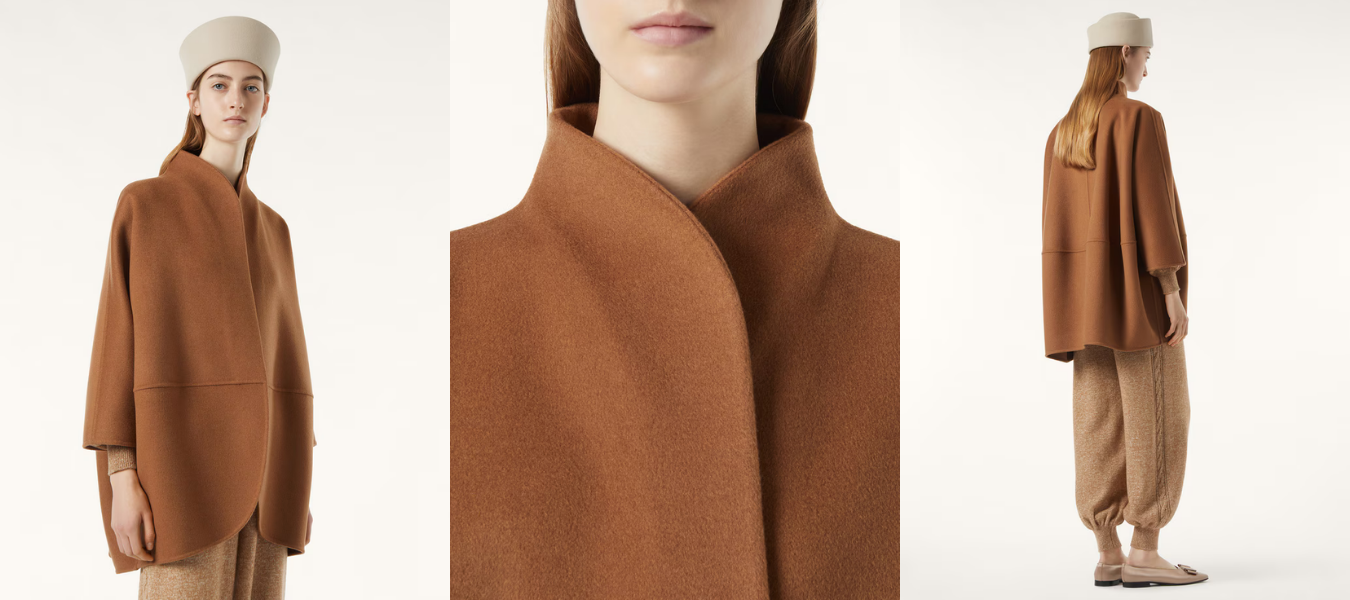
The vicuña is the smallest of the camelids, a slight, cinnamon-coloured animal that lives wild above 4.000 metres in the Andes. It weighs under fifty kilograms. It is the national animal of Peru, and under the Inca it was sacred: the fibre was reserved by law for royalty, and anyone else found wearing it faced execution.
The reason is measurable. Vicuña fibre averages around 12,5 microns in diameter, finer than the best cashmere, which runs to 15 or more, and roughly a seventh the thickness of a human hair. The animal developed it to survive an environment that swings from scorching daytime sun to sub-zero nights, and the result is a fleece with thermoregulating properties no synthetic has matched.


© Loro Piana
The Arithmetic of Scarcity
The numbers are what make this material different from every other luxury fibre. A single vicuña can be shorn only once every two years, and perhaps five times in its life. Each shearing yields between 120 and 150 grams of usable fleece. The fibres are extremely short – two to four centimetres which makes them difficult to spin and requires dehairing so painstaking it can take hundreds of hours per kilogram.

© Loro Piana
The consequence: it takes the fleece of roughly thirty-five animals to make one overcoat.
There is no way to industrialise around this. You cannot farm vicuñas intensively; they are wild animals adapted to extreme altitude and they do not thrive in enclosure. You cannot shear them more often; the fleece will not have regrown. The supply is fixed by biology.
How the Species Was Saved
That value nearly destroyed the animal. Colonial and then commercial hunting, killing was simpler than catching, reduced a population that had numbered in the millions before the Spanish arrival to somewhere around 6.000 individuals by 1960. The vicuña was listed as endangered and Peru established its first reserve.
Protection alone would probably not have been enough. What changed the outcome was the revival of an Inca practice.
The chaccu is a communal roundup. Hundreds of people from Andean villages form a human chain across the high plateau and walk slowly inward, gathering the animals into enclosures. The vicuñas are shorn by hand and released, unharmed, the same day. Under the Inca it took place once every four years, accompanied by ceremony. It still does, with the dances and songs largely intact.
In 1994, Loro Piana, heading an international consortium, signed an agreement with the Peruvian government and the Andean communities granting rights to buy, process and export fibre gathered this way. The critical clause was the one that put the communities inside the economics. A village that earns substantial income from live, healthy, regularly shorn vicuñas has a direct interest in there being more of them next year.
It worked. The IUCN reclassified the vicuña from endangered to least concern in 2008. Populations across Peru, Bolivia, Chile and Argentina now run into the hundreds of thousands. In 2008 Loro Piana established Peru’s first private nature reserve, the Dr Franco Loro Piana reserve, and extended the model to Catamarca in Argentina five years later.


© Loro Piana
Visit Loro Piana Official Website
Why It Matters Beyond the Coat
It is worth being clear about what this is. It is a case in which the luxury industry’s demand for an extremely expensive material became the mechanism that saved the species producing it, not through philanthropy, but through an economic structure that made conservation more profitable than poaching.
That is rarer than it should be. Most heritage-craft arguments in fashion are about preserving human skill: the tanneries and mills that sustain Made in Italy, or the hand-padded canvas that separates Savile Row from Naples. The vicuña argument is about preserving an animal, and it is the strongest answer the industry has to the charge that its materials are simply extracted.
The threats now are different. Rising temperatures and drought in the Andean highlands are reducing the grassland the animals graze, forcing unnatural migration. Poaching has not disappeared. A species restored is not a species secured.
None of which is visible in the finished cloth, which is the point. Vicuña has no sheen, no drape that announces itself, no obvious signal. It is the most expensive fibre on earth and, worn, it looks like a plain camel-coloured coat; the original argument for restraint, made several thousand metres above sea level.
Featured photos: © Loro Piana