
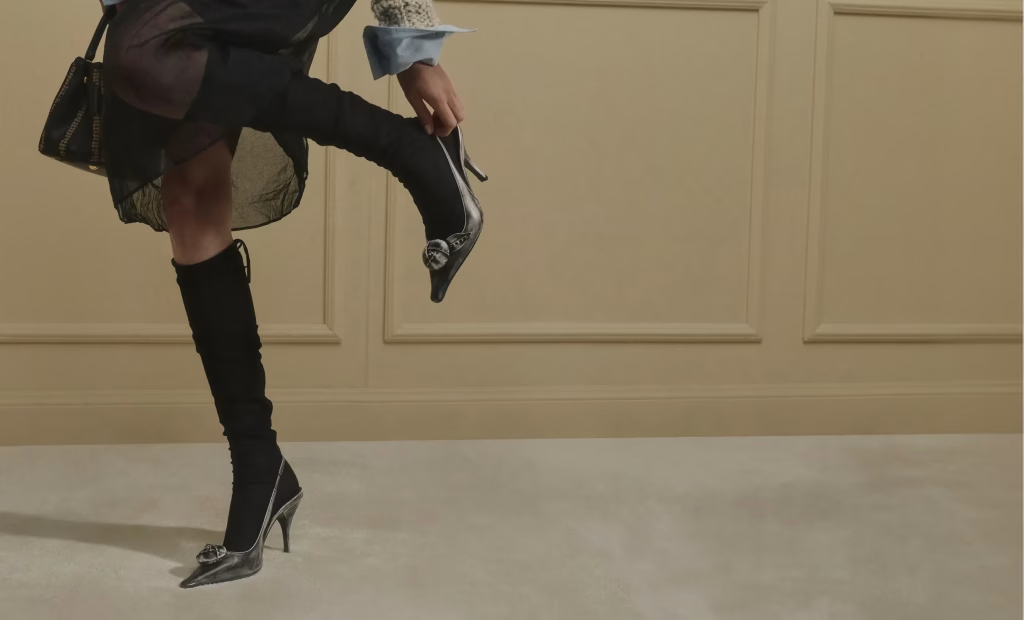
A year ago, fashion month was a procession of first impressions. Fifteen creative directors began their tenures across the four cities; Jonathan Anderson at Dior, Matthieu Blazy at Chanel, and a dozen others besides. The industry watched debuts, and debuts are generous things. A first collection is graded on nerve and intent. Nobody expects a language yet.
The Spring/Summer 2027 season, which runs from 10 September through to 6 October, offers no such indulgence. New York opens on the 10th, London follows on the 17th, Milan takes the 22nd through the 28th, and Paris closes from the 28th to the 6th of October. It is a season of second and third collections, and second collections are where reputations are actually made. A striking entrance can be improvised. A coherent point of view sustained across three consecutive outings cannot.
The proving ground
Milan carries the heaviest load. Demna’s second ready-to-wear collection for Gucci, Maria Grazia Chiuri’s second at Fendi, and Meryll Rogge’s second turn at Marni all land inside a single week, three of the most consequential appointments in Italian fashion, judged simultaneously. Prada has taken the opening slot on Tuesday the 22nd, an unusual position for a house that traditionally shows later, and one that suggests confidence rather than caution. Simone Bellotti makes his debut at Jil Sander. Giorgio Armani’s evening show retains its traditional place closing the calendar.
Milan also hosts Vogue World: Milano on the opening day, staged in the Galleria Vittorio Emanuele II and built around Italian craftsmanship and the human hand, a theme that reads as pointed in a season otherwise preoccupied with technology.
New York opens with Henry Zankov’s debut at Diane von Furstenberg, and the front-loaded schedule that defined last season continues, with Michael Kors, Proenza Schouler and Calvin Klein Collection clustered into the first days. London, from the 17th to the 21st, has a homecoming quality this year, with McQueen and Mulberry both returning to the British calendar.
The question underneath
There is a larger matter that these four weeks will settle, and it has nothing to do with individual houses. We argued earlier this year that quiet luxury had given way to something considerably louder – that after several seasons of camel coats and invisible logos, the runways had turned the volume back up.
The unresolved question is whether that was a correction or a direction. One season of maximalism is a reaction; two seasons is a movement. If the Spring/Summer 2027 collections hold the line; colour, volume, ornament, the visible hand, then the quiet years are properly over and the next several seasons of luxury retail will look markedly different. If the houses retreat towards restraint, we will know that last season was the runways clearing their throat.
Watching it properly
The temptation with fashion month is to consume it as a highlight reel – the ten images that circulate, the front row, the finale. That is the least informative way to read a season. The useful signal is repetition: the silhouette that appears in three cities without collusion, the fabric weight that keeps recurring, the accessory proportion that four unrelated houses arrive at independently.
Those convergences are what actually reach the shop floor eighteen months later, and they are visible only to people watching the whole month rather than the highlights. Milan’s final day this year is entirely digital, coinciding neatly with the first day of Paris, a small logistical courtesy that also tells you something about where the industry now places its physical attention. By the evening of 6 October, we will know whether fifteen new voices have become fifteen new houses, or whether some of them were only ever a very good first night.
Visit the official Prada website
Featured photo: © Prada