
 4 min read
Any conversation about Vienna inevitably turns to the balls—more than 450 a year, beginning like clockwork on November 11 and carrying the city through the darkest days of winter until spring.
The Opera Ball is the most famous. Debutante couples, around 160 in all, dance to “The Blue Danube” waltz in a ceremony that hasn’t changed much since the 1800s: long gowns for the ladies, tailcoats and white bow ties for the gentlemen, and a theater full of onlookers. The Vienna Philharmonic Ball is the more glamorous ticket, drawing musicians, diplomats, and old Viennese families. But the events don’t stop there. There are balls for lawyers, coffee brewers, hunters, bakers, and scientists—nearly every social stratum of the city has one.
Glamorous, isn’t it? There’s something defiantly optimistic about an entire city collectively agreeing to put on its best finery and waltz until dawn, over and over, for months and years and now centuries on end. What began as a favored pastime of the 18th-century Habsburgs persists to the present day as a genuine focal point of civic life, rather than a costume drama staged for visitors. (Though outsiders are indeed welcome, with tickets available online to most anyone with the right dress and willingness to make the trip to Vienna in winter.)

Lobmeyr lights at the Golden Hall of the Musikverein, a concert venue.
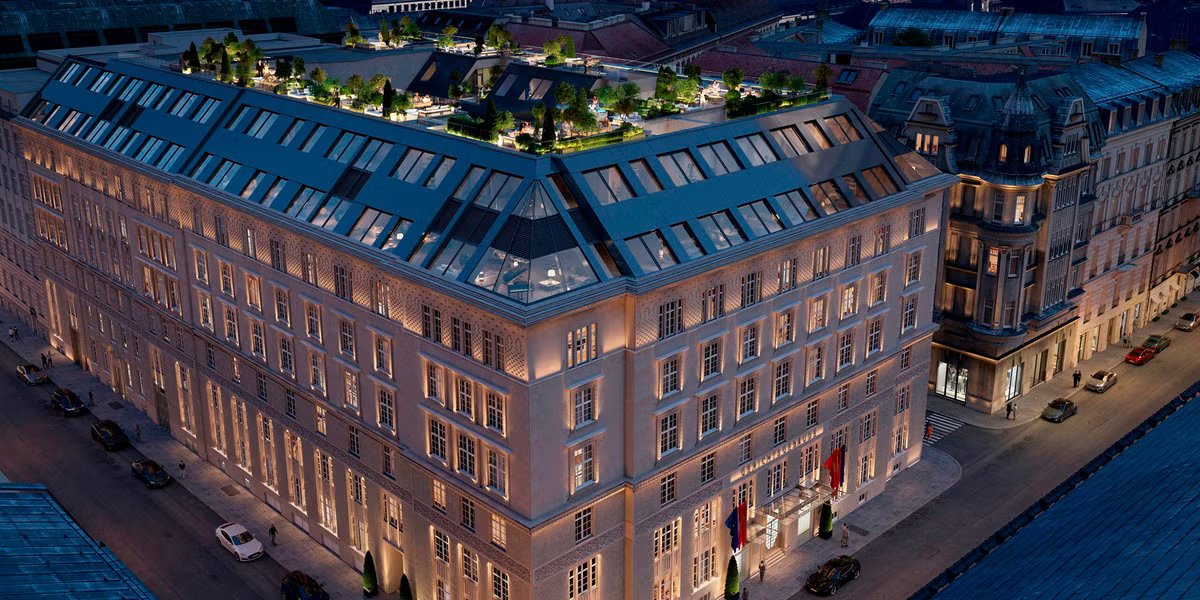
According to the Vienna Tourist Board, the city saw a record number of visitors in 2025, and luxury investment has followed close behind. Yet unlike so many capitals racing to reinvent themselves, Vienna has resisted the temptation to prove its relevance with glass towers and modern architectural statements. Nearly all of the city’s most exciting hotels are rooted in old buildings: The Rosewood Vienna debuted in 2022 in a 19th-century former bank headquarters, while the Mandarin Oriental, Vienna opened late last year inside a restored Art Nouveau courthouse. This past summer brought the long-anticipated relaunch of Palais Coburg, a five-star hotel set inside the former home of the Saxe-Coburgs, an aristocratic family with ties to the British royals. Next year will see the return of the romantic Hotel Bristol, a Belle Époque landmark. Meanwhile, at the Hotel Sacher—a bastion of old-world luxury that turned 150 this year—the rooms are as opulent and the chocolate Sacher-Torte as decadent as ever.
Vienna’s great luxury is continuity. Here, older buildings tend to be patiently restored, sometimes over decades, with an appreciation for authenticity, celebrated for their heritage rather than gutted for the next new thing. That same instinct makes Vienna one of the most rewarding shopping destinations in Europe. The Innere Stadt old town is a treasure trove of family-run ateliers and retailers. At J. & L. Lobmeyr, the firm whose Sputnik chandeliers famously illuminate the Metropolitan Opera House in New York, crystal is still cut and engraved by hand, as it has been since the company’s founding in 1823. Carl Auböck, established in the early 1900s, continues to produce sculptural brass and leather objects using techniques passed down for generations. The tiny chocolate shop Altmann & Kühne, open since 1928, wraps its creations in elaborate foils and boxes that still capture the glamour of bygone times. None of it feels preserved for tourists—in the age of same-day delivery, these businesses never stopped believing there was value in doing things slowly, and in person.

Lobmeyr crystal pieces.
Fashion designer Nina Hollein, who was born in Vienna and lives in New York, sees that continuity everywhere when she returns—her father lives in the apartment where she spent her childhood, unchanged in the last 55 years. She always visits her usual circuit of favorites: breakfast at Café Goldegg, exhibits at the Kunsthistorisches Museum, the 7th District for shopping, a nightcap at Café Engländer. “To my absolute delight, I often find many of the same old friends sitting in the same old bars and restaurants, talking about the same things with the same sharp humor and cynicism,” Hollein says.
Not everything in Vienna is tied to the past. The city’s luxury retail landscape expanded last year with the arrival of Austria’s first Loewe and Celine boutiques, alongside Dior’s 11,000-square-foot shop. The city’s museums have followed: The “True Colors” exhibit at the Wien Museum traces four centuries of Viennese fashion, while the Leopold Museum’s “Modern Fashion: Wiener Werkstätte & Paris,” set to open in February, will examine how Viennese designers influenced contemporary style. Meanwhile, the MAK Museum of Applied Arts in Vienna has reorganized its entire permanent collection around the fin de siècle moment.

A bedroom in the Wiener Philharmoniker Suite at the Hotel Sacher.
Art remains central to the Vienna experience. Last month, the Albertina Museum, celebrating 250 years, opened a major exhibition of Pablo Picasso and Francis Bacon. And the city’s local icon, Gustav Klimt, remains everywhere. Guests who book the Klimt Suite at Almanac Palais Vienna can now experience an original Klimt drawing, “Seated Lady from the Front” (1913–1914), in the comfort of their room; enjoy a private two-hour city tour exploring the artist’s life; and get exclusive access to the world’s largest Klimt collection. Next year marks the 200th anniversary of Beethoven’s death, and the city is already planning an ambitious calendar of performances that will once again remind the world why Vienna was Europe’s classical music capital.
That may be Vienna’s greatest strength. Unlike cities racing to reinvent themselves to claim their share of affluent travelers, Vienna has almost stubbornly refused to change its personality. This is a city that has spent generations perfecting its traditions rather than replacing them. Now seasoned travelers understand exactly what Vienna has known all along: It is beauty made by hand and rituals practiced without irony that keep a city alive.
This story appears in the October 2026 issue of ELLE.