
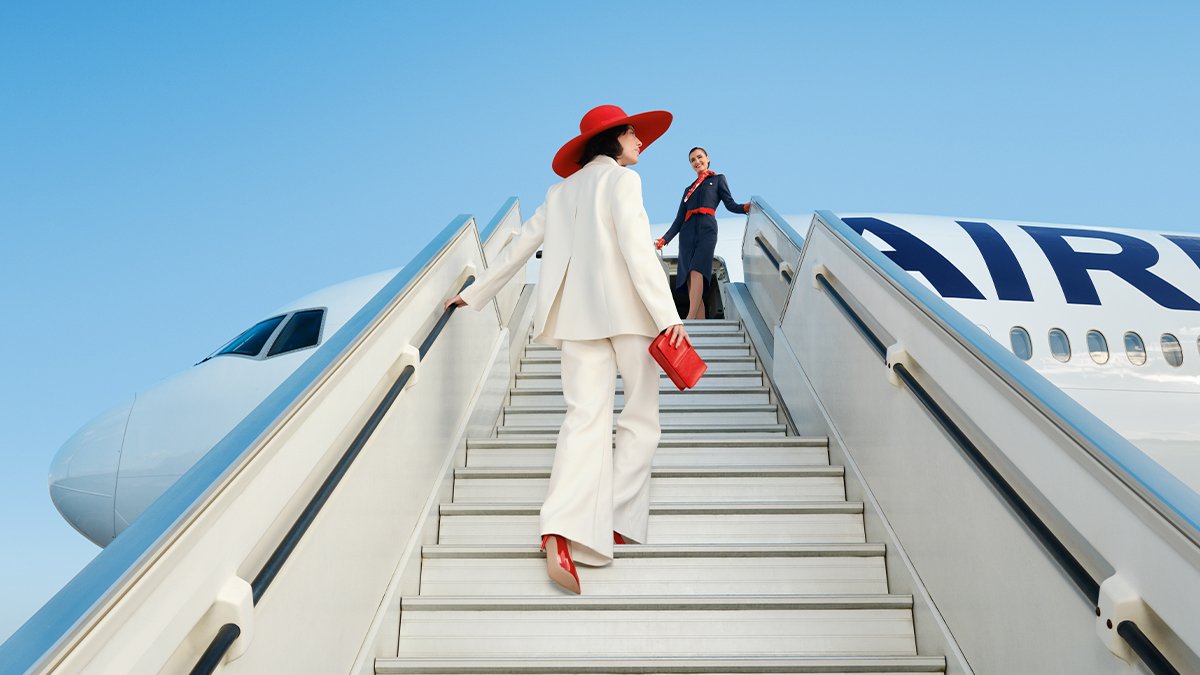

Air France’s La Premiere Suite is on certain Boeing 777-300ER aircraft, including one route from San Francisco International Airport.
In the latest air travel developments, Air France has unveiled a new, super luxurious first class experience on a daily San Francisco-Paris flight as U.S. one-percenters demonstrate an ongoing demand for high-end trips; American Airlines unveils a big overhaul of its single-aisle domestic fleet, including the return of seatback screens and an expansion of premium seating; Delta is also pushing the premium envelope with larger Delta One cabins aboard new wide-bodies and expanded first class seating on some single-aisle domestic aircraft; the latest consumer price index shows that airfare increases are still the primary cause of higher travel costs; JetBlue clears a regulatory hurdle that should let it begin installing first class seats next month; San Diego’s airport announces the start of major construction work on roadways that could impact traffic; Sacramento International Airport opens three new food and beverage outlets.

There’s been a lot of press coverage this year about the continuing demand for high-end luxury travel from the wealthiest Americans, and now Bay Area one-percenters have a new way to satisfy those urges. Many global carriers have phased out first class seating as business class gets more luxurious, but over the past several months, Air France has been installing new super-premium La Premiere (first class) cabins on some of its long-haul 777-300ERs, and now it has deployed one of those planes on one of its two daily flights from San Francisco to Paris (the other uses an Airbus A350-900). The airline’s La Premiere experience starts at airport arrival, where a porter takes the customers’ bags and escorts them to a private check-in lobby; then they enter an exclusive La Premiere lounge with a gourmet dining area and other luxury amenities. As departure time approaches, staffers drive the first class guests from the terminal to the aircraft in a hybrid Porsche Cayenne. The aircraft has just four first class suites, each one equipped with five windows, a seat that “adjusts to each passenger’s body,” and a day bed that transforms into a 2-meter-long bad flat bed, Air France said. Each suite is enclosed by a thick mesh privacy curtain. Suites also have two 32-inch entertainment screens, Bluetooth, power and USB outlets and more high-tech amenities.
Article continues below this ad

Inside La Premiere Suite aboard select Air France flights, including a route to Paris from San Francisco.
A study earlier this year from the Resonance Consultancy found that people in the top 1% of U.S. household incomes take an average of six leisure trips a year, spending an average of $12,400 per trip, while the average consumer spends $3,700 per trip. Air France’s announcement didn’t mention what kind of fare La Premier customers can expect to pay, but it could test the limits of even the one percent. The San Francisco Business Times reported this week that round-trip fare on Air France’s La Première from SFO to CDG in October starts at more than $31,000.

An American Airlines flight lands at Ronald Reagan Washington National Airport on Aug. 13, 2026.
Nine years ago, American Airlines made a strategic decision to take the seatback screens out of its single-aisle domestic aircraft,
Article continues below this ad
The airline said it is adding an extra row of first class seats to its Airbus A319s and 320s, while the new Boeing 737 Max 10s it has on order will come with 24 first class seats, and Airbus A321neos will be retrofitted with the same number. American recently announced plans to install high-speed Starlink Wi-Fi on its narrow-body fleet, and it will be accessible on new 4K seatback screens on all new Airbus and Boeing single-aisle planes delivered staring in 2028. The screens will also be installed on existing aircraft. The narrow-body fleet will also get fast USB-C charging ports at each seat and Bluetooth audio connectivity. One Mile at a Time’s Ben Schlappig called American’s addition of more premium seats “great news,” noting that its most common narrow-bodies — 737-800s and 737 Max 8s — have just 24 Main Cabin Extra seats. “It’s just ridiculous how hard it is to score one of those seats, especially if you’re traveling with family, and can’t sit in an exit row,” he said. “Compare that to the same planes at United (which has 54 Economy Plus seats) and Delta (which has 36 Comfort+ seats). So I’m very much looking forward to that.” View from the Wing’s Gary Leff said American’s announcement means it is “reversing a decade of cabin mistakes.”

A Delta Air Lines flight in 2020.
When it comes to expanding premium seating at the expense of the economy cabin, Delta has been at the front of the pack, and apparently it intends to stay there. According to a report in the Live and Let’s Fly blog this week, Delta has ordered 16 new Airbus A330-900neos this year for delivery starting in 2029, and it intends to equip them with 56 Delta One (i.e., international business class) Suites. Its current A330-900neos have just 29 Delta One suites. It hasn’t yet revealed the rest of the configuration for those aircraft, but “A 56-seat Delta One cabin on an A330-900neo is enormous,” Live and Let’s Fly remarked.
Meanwhile, we reported earlier this year that because a government regulatory delay has kept Delta from installing new lie-flat first class seats in its domestic A321neos for a couple of years, the airline decided to fill that space for now with 44 domestic first class reclining seats — compared with just 20 on its other single-aisle planes. “The cabin, which spans 11 rows, takes up almost half the aircraft,” the Points Guy noted, calling it “an ambitious bet for the airline.” But Delta chief commercial officer Joe Esposito told the Points Guy in an interview that it has been selling about 80% of those front-cabin seats on average. “It’s a great experiment to see how big our first-class cabin should be for the future,” Esposito said. “It’s not a mystery, we have high demand in those cabins.”
Article continues below this ad
Major airlines have been warning in their financial reports that travelers shouldn’t expect to see relief any time soon from the sharply higher airfares that have been in place this year, especially since the price of jet fuel shot up after the beginning of the Iran war. In the past few months, U.S. airfares have been running more than 25% higher than they were a year ago, and the government’s latest consumer price index shows little change in that pattern. During July of this year, the Bureau of Labor Statistics said, airline fares were 25.5% higher than they were during the same month a year ago, compared with an overall national inflation rate of 3.4% year over year. That July airfare figure included a 2.2% increase from June 2026 levels. Jet fuel prices did start to come down in July, according to the U.S. Travel Association, but as a temporary ceasefire crumbled and hostilities in the Middle East heated up, the prices went back up again.
“Travel costs year-over-year remain elevated, with high airfares continuing to be the primary driver behind the increase,” said NerdWallet, which compiles its own travel inflation report. It found that overall average U.S. travel costs this summer are 9% higher than the same time last year.
“Airfare costs are up 25.5% over the past year, while the cost of eating out and entertainment is up 3.4% and 2.3%, respectively. Lodging prices are also up year-over-year, with a 2.6% increase,” NerdWallet said.

A screen on the back of a seat on a JetBlue Airways plane, at Logan International Airport in September 2025.
JetBlue first announced its intention to add first class seating about a year and a half ago, and now the airline has cleared a major hurdle in deploying that new product: It has gained Federal Aviation Administration approval for the new seats, Simple Flying reports, so it should be able to begin installations on its Airbus jets. The new first class section will be going into JetBlue aircraft that don’t already offer its posh Mint service — a front-cabin premium option with lie-flat seats offered on select long-haul transcontinental and international routes. JetBlue’s first class section will be branded BlueFirst, with two or three rows of two-by-two seating. The seats won’t lie flat, but they will offer more recline and greater seat width than existing main cabin seats. In terms of price, BlueFirst seats will be in between Mint and its EvenMore extra-legroom product. The company is expected to begin overhauling its fleet around the third week of September. “A revised September 21 start date suggests that the carrier could have upwards of 60 aircraft completed by year-end,” Simple Flying said.
Article continues below this ad

In airport news, the San Diego County Regional Airport Authority said it has started work on a major overhaul of downtown roadways around the airport, a project that is expected to continue through fall of 2027. The work is intended to improve traffic flow and make airport access easier, though it could create some increased congestion while it is underway. “The multi-phase project will improve Grape Street, Palm Street, and Pacific Highway through roadway rehabilitation, traffic signal modernization, railroad crossing enhancements, accessibility improvements, separated bicycle lanes, upgraded street lighting, and added vehicle capacity where needed,” the airport authority said. It noted that to minimize impact on traffic, construction on Grape Street will be restricted to 11 p.m. to 5 a.m,. Sundays through Thursdays, while work on Pacific Highway will be scheduled for 7 a.m. to 4 p.m., Mondays through Fridays. Work on Palm Street isn’t expected to start until January 2027, with days and hours to be announced later.
Sacramento International Airport this week cut the ribbon on three new food and beverage outlets in Terminal B, all locally owned brands operated by High Flying Foods. They include Temple Coffee Roasters, a specialty coffee company founded in Sacramento; Nixtaco, serving up Mexican cuisine; and Bawk!, a local outlet specializing in fried chicken. The airport said the new outlets are part of a long-term program to add businesses from the Sacramento region. “When complete, the concessions program will increase the Airport’s food, beverage and retail offerings from 17 to 23 concepts and support approximately 540 jobs,” the airport said in a news release.
Article continues below this ad