
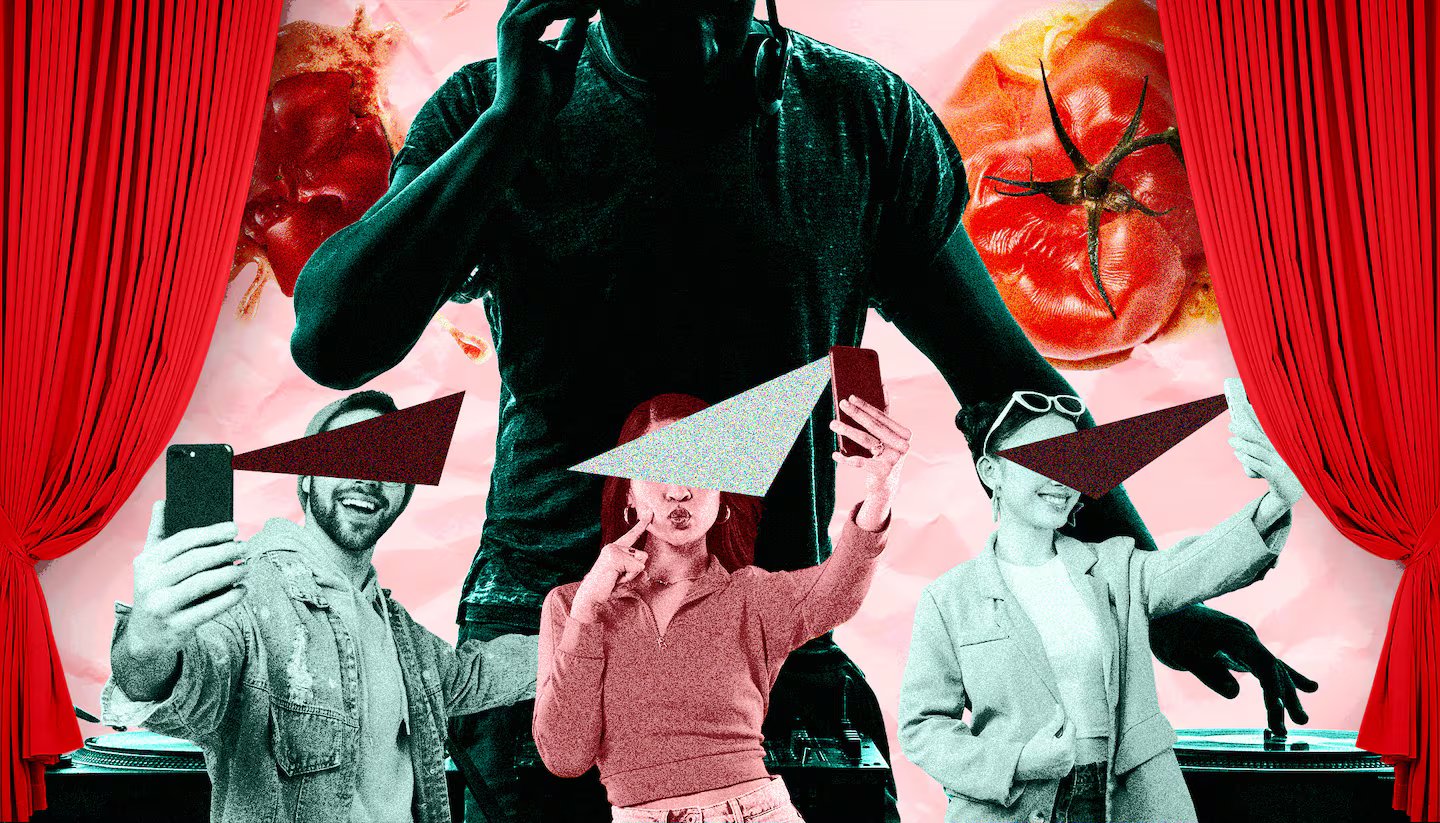
Dancing at nightclubs may become a relic of the past.
Ironically, the issue is that the DJ booth is taking up too much space. The DJ booth is no longer tucked away in a corner; it’s the focal point of the room. The DJ is now the performer, and with that comes people who aren’t fans of music, but of the DJ.
The result? Swarms of people trying to get as close to the booth as possible, snapping pictures, asking for selfies, and doing anything but dancing.
Despite this, DJs say the biggest change isn’t where they’re standing; it’s how audiences behave.
“Half the time they’re on the floor, they’re looking at their phone,” said Alphonse Detemple, a Boston-based DJ. “Genuinely, I see people scrolling … on their phones in the middle of the dance floor.”
Rather than dancing, Detemple and other DJs say, clubgoers crowd around the booth, phones raised, hoping to capture the perfect photo or video of themselves near the DJ booth. Dance floors that were once built for dancing and connection are increasingly filled with glowing screens, leaving DJs to perform for audiences who seem more interested in documenting the night than participating in it.
“Nowadays, DJs are artists; they’re like Taylor Swift; they’re performing for you,” said Johann Pinto, a Boston-based DJ who performs as yoBe. “It’s this weird power dynamic that’s happened. … It’s not about dancing. It’s about seeing the show.”
Pinto said that increased visibility around DJs has made DJing a career that people can pursue to greater fame and success. Think of artists such as Tiësto, David Guetta, and Calvin Harris, who have become household names and elevated the profession into a career with star power. But he believes the celebrity status of DJs has fundamentally changed club culture, making it more performative and less communal.
For many DJs, the shift goes beyond aesthetics. They say audiences have become increasingly disengaged — and, at times, disrespectful.
Instead of interacting with the music or each other, audiences often push toward the booth to take pictures before returning to their phones.
“I notice just being in the crowd that no one is dancing,” Detemple said. “Everyone is pushed to the front with a camera in the DJ’s face, even though there’s so much space in the back.”
The behavior doesn’t stop at the dance floor. Behind the booth, DJs say audience members increasingly cross boundaries by treating the performance as an interactive attraction rather than a workspace.
Detemple recalled one night when an intoxicated audience member repeatedly reached over the booth and touched his equipment.
“This girl is just hammered, and she’s touching the decks every now and then,” he said. “Mid-song, you’ll hear the music cut out and scratch. I cannot believe the lack of respect or awareness. Entitlement is literally the best way to describe it.”
DJs say these interactions reflect a broader cultural shift. As more clubs become driven by exclusivity — using social media marketing as a way to make clubs look more appealing and drive profit — the audience starts to reflect these values.
“Most events that you’re going to be looking at are just straight bottom-line ROI,” Detemple said, about the perspective of club owners. “‘How do we increase this profit margin?’ They’re not really looking at the music itself, but the artist: How much money will he bring us?”
Pinto said the focus on image has created new dynamics within nightlife.
“I think that’s why there is this social hierarchy,” he said. “If I’m behind the DJ booth, I’m part of the performance, [and] therefore you’re watching me. People want to be watched. They want that attention.”
“In nightlife, there was this level of intimacy which allowed people to just be themselves, and I think that intimacy has been broken,” he said.
Boston DJ Ella Bahari, who performs as Elaheh, believes the obsession with visibility has fundamentally changed people’s behavior when they go out.
“People don’t dance because they’re scared of what they look like,” Bahari said. “If someone could go to a DJ set but couldn’t tell anyone they went, would they still want to go?”
She argues that social media has made clubgoers increasingly self-conscious, replacing spontaneity with performance.
The pressure to perform also extends behind the booth, particularly for women.
DJ booths are often filled with attractive women to create the appearance of exclusivity, Bahari said, reinforcing a nightlife culture that prizes appearance over music.
“Women are pawns in this big chess game,” she said. “It’s ruined my sense of going out.”
As one of the few women regularly performing in Boston clubs, Bahari said she also faces a different kind of audience disrespect.
“Men don’t treat me like someone who’s working,” she said. “They think I got here because I’m a woman, not because of my music.”
For DJs, it all adds up to audiences treating nightlife as something to consume rather than something to participate in.
“What I really envy about previous generations is that people could go out and be crazy and do whatever because they weren’t afraid it would be captured,” Pinto said.
Today, DJs say, the dance floor has become a stage where everyone is performing — but very few people are actually dancing.
“The way a DJ measures success isn’t by pictures, it’s by people dancing,” Bahari said.
Read more stories from our People Watch series:
Celine Hijazi can be reached at celine.hijazi@globe.com.