
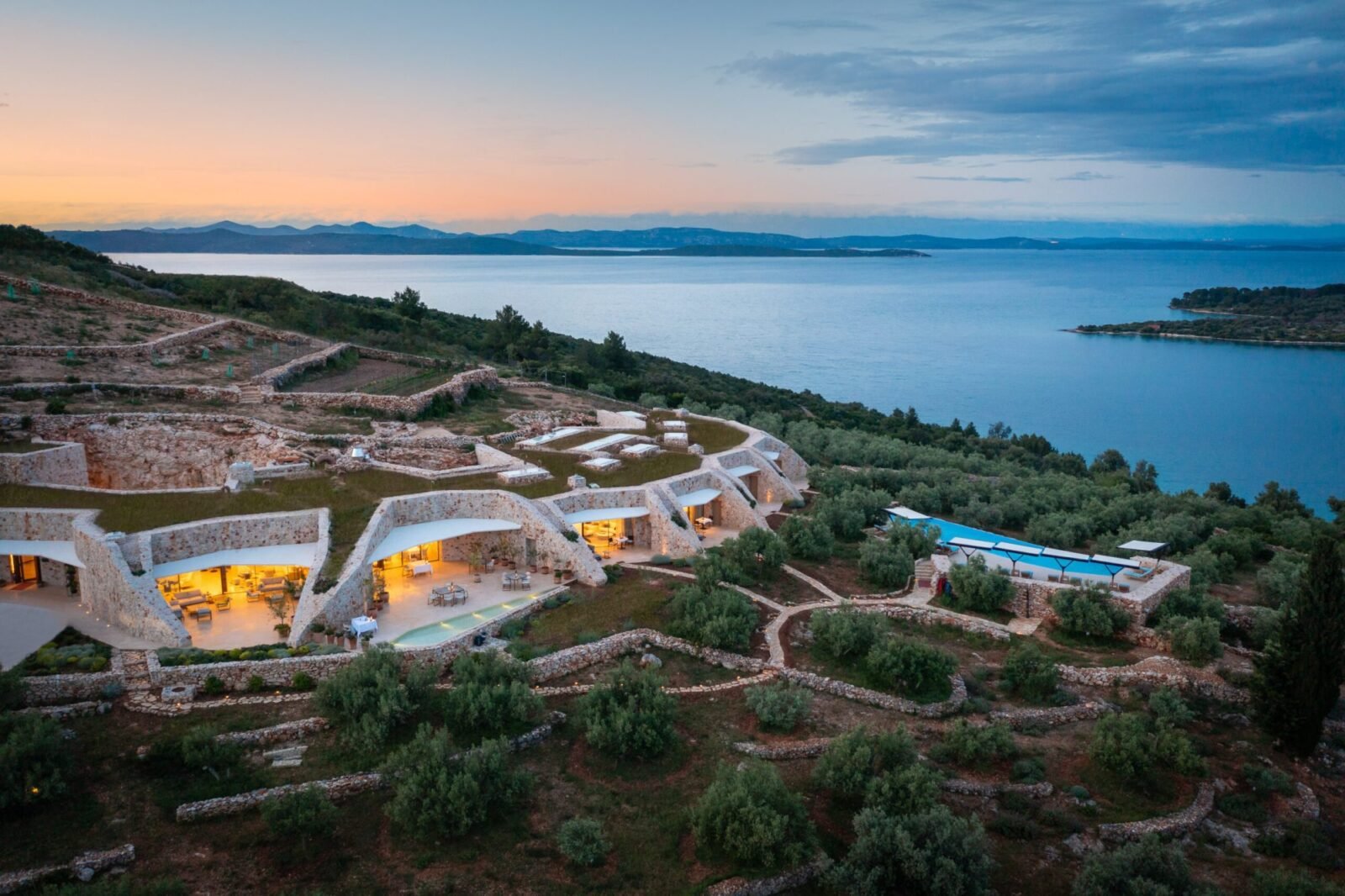
The most decorated hotel in Croatia is not in Dubrovnik, or Hvar, or anywhere a visitor would think to look. It is eight rooms cut into a hillside on Dugi Otok, an island twenty-seven miles long and three across, with a resident population under fifteen hundred, reached by catamaran from Zadar in about an hour. Villa Nai 3.3 holds three Michelin Keys — the Guide’s highest hotel distinction, awarded to just 143 properties worldwide. It is the only Croatian hotel to hold them. That fact deserves rather more attention at home than it has received.
Snow, of all things
The name requires explanation, and the explanation is the whole property in miniature. Nai is old Dalmatian for snow. Dugi Otok receives, by long-term measurement, an average of 3.3 days of snowfall a year — which happens to be precisely the amount that produces a superior olive harvest.
The Morović family have farmed olives on this hillside for five centuries. Goran Morović, a civil engineer by training, and his wife Nives did not set out to build a hotel; they set out to build a proper mill for an oil that had begun collecting international awards, and concluded that guests might reasonably want to sleep near it. What exists today is an estate of some forty thousand square metres in which accommodation, an operating oil mill and a tasting room sit under one roof — reportedly the only property in the Leading Hotels of the World to incorporate a production facility, and among the smallest in that collection.


Visit Villa Nai 3.3 on Instagram
The architecture of not being seen
In 2013 Morović approached Nikola Bašić, the architect responsible for Zadar’s Sea Organ — the installation that turned a stretch of concrete waterfront into an instrument played by the Adriatic. Bašić’s response here was to excavate the interior of the hill and put the building inside it.
The exterior structures are low, built from stone taken out of the hillside during excavation; even the concrete was made from the same material. A green roof completes the disappearance. From the grove above, there is very little to see. Inside, the organising idea is a yacht. Bašić has said he wanted the sensation of being aboard, in constant contact with the elements, and the five rooms and three suites are laid out accordingly — cabin logic, generously scaled, each framing either olive trees or open sea. The private terraces read unmistakably as decks. Sliding glass by Sky-Frame, furniture by Giorgetti, bathrooms by Agape, linen by Frette: the specification is Italian and quiet throughout, which is the correct instinct in a building whose entire argument is restraint.


© Villa Nai 3.3
What it is for
Two restaurants, 3.3 and Grotta 11000, cook the island — line-caught Adriatic fish, produce from the surrounding farms, the estate’s own oil as the through-line. Both are open to visitors as well as guests, which matters on an island with few alternatives. There is a seawater infinity pool, an indoor saltwater pool, a spa built around olive-derived treatments, a clay tennis court and a helipad. Guests are welcomed from the age of twelve. The season runs roughly April to October.
The surroundings do the rest. Telašćica Nature Park sits at the island’s southern end; the Kornati archipelago — 140 islands and islets, 89 of them within the national park established in 1980 — begins immediately beyond. The hotel positions itself as equidistant between Venice and Dubrovnik, which is geographically true and rhetorically clever: it places Dugi Otok on a line rather than at an edge.

The wider point
Croatia’s hospitality conversation has, for two decades, been conducted almost entirely in terms of coastline and old towns. Villa Nai 3.3 makes a different argument — that the country’s most valuable assets may be its agricultural landscapes and the families who have worked them, and that the correct response to a five-hundred-year-old olive grove is to build something that hides inside it.
It is a lesson the Adriatic could stand to learn more widely, and one we have watched play out elsewhere in Dalmatia, where the region’s grander hospitality traditions take an entirely different and equally valid form.
Featured photo: © Villa Nai 3.3