

Boston’s nightlife gets a bad rap as “no New York,” which is to say the city dozes off before 3 a.m.
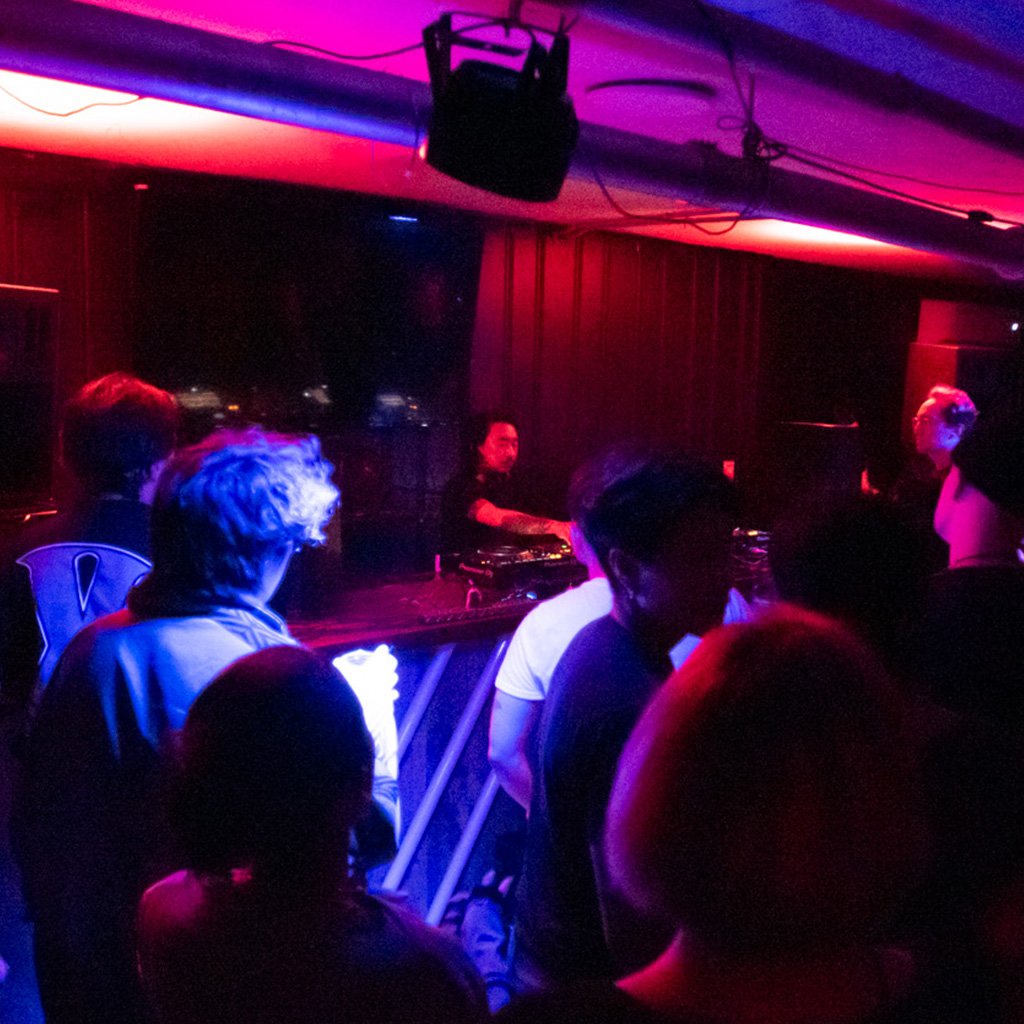
But until then, there’s life across the Charles River and underground in Cambridge’s Central Square, literally: The Lower Level nightclub at 55 Bishop Allen Drive is a basement establishment, complete with low ceilings, wood panels, a foosball table and a dartboard. Its wide-awake patrons nod and bop with a primal sort of rhythm, their identities illuminated momentarily by red and blue strobes. Similar scenes are a short walk away.
Advertisement

Jose Zamora, known as Profiler on the dance floor, carries a hypnotic techno pulse from his controller with enough bass to give partygoers a second heartbeat. Zamora is opening for Japan’s DJ Nobu, who traveled to the catacomblike space in Cambridge on Sept. 19 as part of the latest Greater-Boston-and-beyond “Infra Presents” event.
Infra is a multi-DJ residency booking the occasional internationally touring artist. As Infra’s crew leader, Zamora seeks out DJs who “take it seriously” and understand the culture of underground experimental techno music. A good DJ makes people dance by simple room-reading: “Play the right music at the right time at the right place,” he said.
Infra’s got options when it comes to performance spaces – it draws fresh DJ talent to the Phoenix Landing every Tuesday and hits Descent, at 33 Dunster St. in Harvard Square, each month or so, for example. But there’s a shortage of truly techno-suited venues, Zamora said. Most establishments de-emphasize dancing to focus on table service to meet bar minimums.

“Techno is not about table service. It’s about dancing, and people don’t drink as much,” Zamora said. “So it’s finding the places like this place that allow us to do it. There’s not a lot of profit to be made.”
Zamora grew up in Paris, traveling to Boston to visit his brother in the oughts before relocating to Cambridge in 2011.
He calls Central Square the “mini-Brooklyn of Cambridge or Boston” for its concentration of bars, restaurants and clubs. Cambridge has an edge over Boston in terms of creativity and friendlier licensing, Zamora said, but lags behind other parts of the globe for crowds.
“DJ Nobu could play in Europe for thousands and thousands of people, and here, it’s 150 people,” Zamora said. He chalks it up to cultural differences and a general hesitancy on the part of Bostonians to go out, given the cost and lack of late-night transit options.
DJing scene diversifies
No more than three blocks over and two hours earlier, DJ Kibbee Miller, or Stealth Mode, wrapped up a set at a Central Square Night Market. Miller actually got her start DJing during daytime parties in 2014 and exploring the scene with friends.
“There weren’t many places that played music that we liked to listen to,” Miller said, “or music that was being played by people that looked like us.”

A DJ friend of Miller’s in Boston connected her and her friends with the owners of Middlesex Lounge, who allowed the group to host Sunday parties. They formed the group Collective.
“We would kind of come out of pocket to bring talent to Cambridge and Boston, and then it got super popular,” Miller said. “We won the Best of Boston Award, like, after our first year of doing this party.”
In the decade since, Miller branched out to other venues, playing three or four events a month at her peak with Collective, including a quarterly show called Pyramids at the House of Blues Foundation Room.
The last gig as a crew was last summer, playing the Institute of Contemporary Art’s annual vinyl nights.
“Some of us have moved away, some of us have moved back since then,” she said.

Once a month, Miller performs with Spin the Bottle (named after how the night’s set order is determined) at State Park Bar in Cambridge’s Kendall Square.
Miller more or less grew up in Cambridge – she was born and raised in Mattapan, but her family owned restaurants in Harvard Square. She’s called Cambridge home for about 10 years now, and finds its DJ scene to be relatively inclusive and tight-knit. There are still representational challenges.
“I feel like sometimes we get kind of pigeonholed into, ‘Oh, we’re looking for women DJs, let’s just hit up this crew,’ versus trying to understand our style or what music we like to play,” she said.
Setting the tone
Miller also wants to see more spacious yet locally owned venues enter the scene. “There are a lot of small rooms and a lot of small restaurants and bars, but there aren’t a variety of, like, actual venues,” she said.
That’s why Berklee College of Music senior Rafael Chandler, 21, known as Between, is not committed to his native Massachusetts.

“Right now I’m just kind of shopping around and looking around different cities in the U.S. for their electronic dance scene,” said Chandler, a major in electronic production and design. “I’m kind of in a place right now where once I graduate, I need to figure out how to make a living.”
Chandler’s DJ credits include the Berklee Electronic Music club’s semesterly DJ night Nocturnia, Dessert First at The Middle East and the DJ livestream Central on Air. Most recently, he played at Dance or Don’t, a free monthly DJ night at Zuzu’s that emerged out of DJ Soso Gutter’s residency at The Middle East.
For about three years, Gutter said, he has run Zuzu “more like a DIY punk night than an electronic dance night,” initially hosting DJ friends and later going open-call.
Building a platform
Landing a residency can be serendipitous, Gutter said. Dance or Don’t came about when he heard of a vacancy at The Middle East. Gutter hosts DJs with a range of experience and lets them play whatever sets they want. Exposing people to different types of music is one of his duties as a more senior member of the scene, he said.
At a certain point in a DJ’s career, “it’s either like you get out of that stuff, or you become an organizer,” Gutter said.

Erik Sarno, general manager for Central on Air, wth a studio on Massachusetts Avenue in Cambridge, meanwhile, hopes to fulfill the platform’s mission of “amplifying and uniting the music community in Boston and beyond.”
Central on Air is in “growth mode,” coming off of perhaps its “biggest collaboration yet” – live-streaming the ICA vinyl nights. Now Central on Air streams live six days a week, up from five a few months ago, Sarno said. Its 1,000th show was Sept. 12; more than 500 DJs have performed live on air in the 15 months since the platform’s launch.
“You would never know that Greater Boston is not known as a nightlife hub,” Sarno said, if you walk Central Square at 11 p.m. on a Friday. “You can catch blues at Cantab. You can go to a rave at Middle East, or a hip-hop show at Sonia. You can dance to DJs at Middlesex.”
Like Gutter, Sarno reflected on his work with DJs being part timing and part passion – he started producing in Central Square as a teen.
“Back in 2013 I was just a young kid with my beats on a CD trying to meet artists who were in town at Middle East,” Sarno reflected.
Altar-ing the experience
Seeing a necessity for more fan-owned venues, John Keamy is working on a DJ-centric club, Altar, that he hopes to open in 2027. A nightclub, he says, should preserve and highlight electronic dance music, emphasizing the experience on the dance floor, so among Altar’s assets are better in-house sound systems and an optimal Central Square location. Keamy is well-connected in taking on the project – he’s worked closely with Sarno, and Infra is among its investors.
“If you put an amazing DJ in a shitty venue, it doesn’t really matter how great the music is. If the sound is bad, if the vibes are bad, if it feels gross and dangerous,” Keamy said.
Conversely, if you give a mediocre DJ an amazing room, they might have a fighting chance, Keamy said. A synergy must exist, Keamy explained, and a DJ is the vital component.
“Just because something’s open a little late doesn’t make it pure nightlife.”
This story is part of a partnership between the Cambridge-Somerville Independent and the Boston University Department of Journalism’s Newsroom program.