
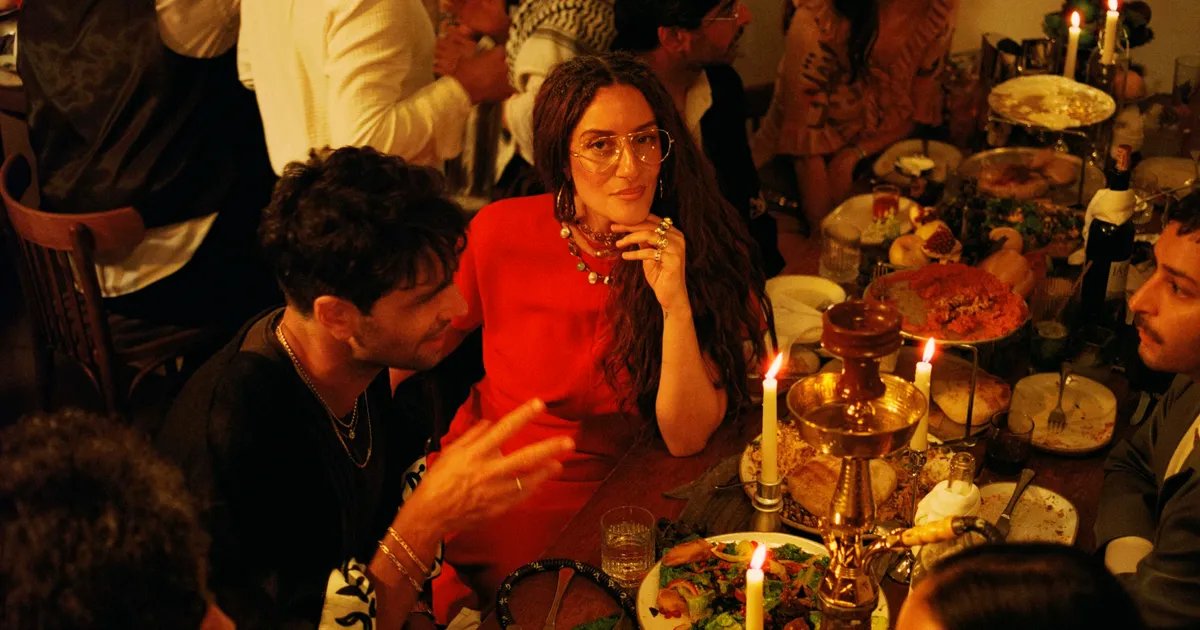

Deana Haggag (center) is the program director for arts and culture at the Mellon Foundation.
Photo: Dean Majd
On an evening in July, we brought together some of the people shaping SWANA New York at Huda, a Levantine restaurant in Williamsburg. Its owner, Gehad Hadidi, is one of those people. Hadidi is a straight shooter who looks you right in the eye when speaking to you: “My name is Gehad — pronounced like jihad — and if a person is put off by that, it’s probably someone that I don’t need to associate with,” he says. In Huda, he’s created more than just a restaurant — it’s become one of the most beloved spaces for the diaspora to gather, to play backgammon, and to cry over soccer all summer long.
Habibi City
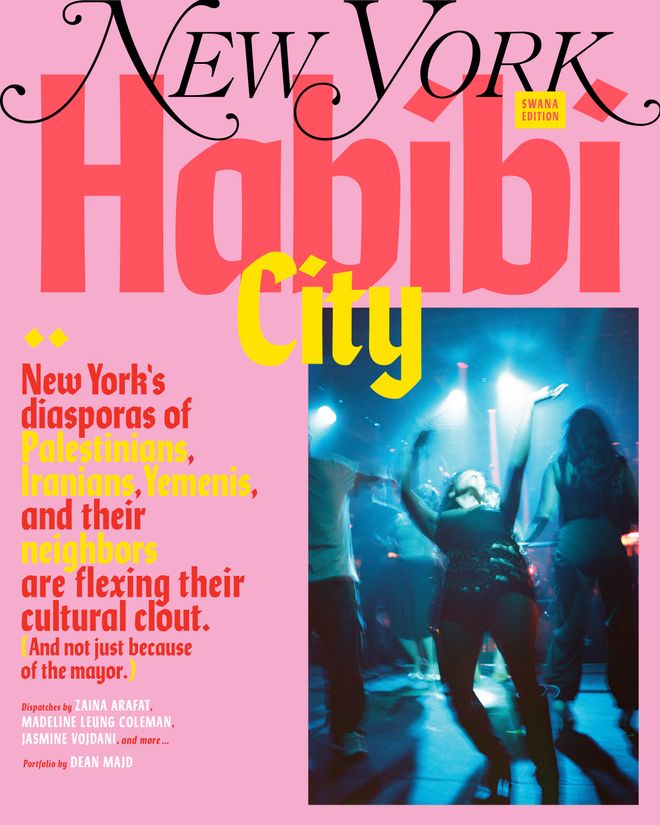
The artists, DJs, chefs, and others featured here were chosen because their work is in some way rooted in the region’s culture and has contributed to the city’s flourishing new scene. Most of them are SWANA — the increasingly popular alternative to “Middle Eastern,” encompassing those from Southwest Asia and North Africa — while some hail from the broader region and have helped build community all the same. Many of them came up together, supporting each other’s projects and giving each other work: At Huda, Hadidi has hosted the artist Sabri Sundos’s tatreez workshop; the singer Mona Miari is a regular at Barzakh Café, owned by El Atigh Abba; Wael Morcos created the visual aesthetic for the New York Public Library’s first exhibit on SWANA New Yorkers, which was curated by Hiba Abid; and on and on and on.
El Atigh Abba, 38, is likely the first face you’ll see upon entering Barzakh, the Crown Heights café he opened in 2023. The Mauritanian-born Abba hosts an endless stream of events bringing together the diaspora — a World Cup watch party for Tunisia, a French-language exchange, a Sufi ensemble. The café is known for its live performances, hosting a regular rotation of tarab singers and Umm Kulthum virtuosos, along with world-music artists of all kinds. “I love Arabic music, but if I hear it more than twice a month, I get bored,” Abba says.
Wael Morcos, 40, the graphic and type designer, plays with the shape and texture of the Arabic alphabet, creating original modern fonts of the language with his design firm, Morcos Key. His visual language has helped define the city’s SWANA aesthetic, seen everywhere from the Arabic logo for Zohran Mamdani’s mayoral campaign to the typography for the New York Public Library’s “Niyū Yūrk: Middle Eastern and North African Lives in the City” exhibit.
Mohammed Iman Fayaz, 35, raised in Queens by Indian immigrants, was 22 when he joined two friends and launched a roving party series, Papi Juice, with the mission of affirming and celebrating trans and queer people of color. It is now a mainstay in the party circuit and shows up everywhere from Bushwick to Little Island.
DJ Carmen Sandiego, 38, had already been playing spaces loosely associated with the Arab community but craved a party dedicated to the music she grew up with. With her friend DJ Myyuh, she created Haza, a long-running party series that was among the first in the city to bring Arabic sounds to the fore. She recently announced a new endeavor, a women-only dance party called Habibti Club.
Sara Deniz Akant, 39, a poet, started the reading series Kan Yama Kan with her friend the author Hala Alyan in the summer of 2020. They invited a few poets and friends over to read in Alyan’s backyard as a way to gather safely during the pandemic. Gradually, Kan Yama Kan turned into a series with featured readers, an open mic, and an emcee, Karl Michael Iglesias, who runs the series alongside Akant and Alyan. Within a year, it grew to include musical guests, performance artists, collaborators, essayists, and fiction writers. The series eventually moved to a nearby Williamsburg bar with the proceeds from each event going to organizations like the Palestinian Children’s Relief Fund and mutual aid in Sudan.
Gehad Hadidi, 42, (center) opened Huda New Levantine Bistro, his second restaurant — he also owns the midtown French bistro La Bonne Soupe — in 2023, and in doing so created a restaurant that doubles as a community space, hosting artist workshops and fundraisers for Gaza and Lebanon.
Mona Miari, 32, headlined her first concert at 15 in Jerusalem; since then, the singer-songwriter has brought the traditions of Palestinian music to New York, leading the city’s first-ever Arabic Chorus as its artistic director and collaborating with Roger Waters on a reinterpretation of Pink Floyd’s “Comfortably Numb” for a generation watching a genocide unfold over social media.
Arian Moayed, 46, may be best known for his acting (he was Stewy Hosseini in Succession), but locally, the Iranian American is a key cultural ambassador of SWANA New York. In 2025, his production company, Waterwell, staged an Iranian art festival at St. Ann’s Warehouse centered on a production of the Iran-born Mehr Theatre Group’s minimalist masterpiece Blind Runner. In March, he co-hosted a Persian New Year celebration at the Iranian bar Masquerade, where Mayor Mamdani made an appearance.
Arsh Raziuddin, 34, is a graphic designer and the creative director of Acacia, a magazine by and for Muslims. She most recently led the branding of New York City’s World Cup campaign, including a run of jerseys that sold out over and over.
Sarah Elawad, 29, is the British Sudanese designer behind Sabah Elkair, a fashion line inspired by the high contrast, lo-fi greetings found in the WhatsApp chats of families across the Middle East, North Africa, and the diaspora. She applied the same style to her work on Mamdani’s mayoral campaign and the windows of the Africa Center on Fifth Avenue with her installation When the War Is Over, a response to Sudan’s ongoing conflict.
Malik Elassal, 30, grew up in Calgary, attending Islamic private school. He moved to New York in 2023 after spending a few years performing stand-up about his faith to small-town audiences. These days, he’s recognized most for his role as Samir on FX’s Gen-Z sitcom Adults, but those in the local comedy scene know him as one of the hosts of New Pants, a monthly stand-up show where he’s part of a new class of comedians subverting the self-flagellating tropes that marked the post-9/11 era.
Kashif Shaikh, 43, (left), Deana Haggag, 39, (center), and Zara Rahim, 35, (right) have organized their annual Eid Banquet since the spring of 2024. It grew from a need to come together as a community post October 7. In the years since, it has become one of the most sought-after invites in town, expanding to include more people beyond Muslim New Yorkers. Rahim, who played a crucial role in Mamdani’s mayoral campaign, recalls the comedian Ramy Youssef, a co-host of the banquet, noting that “the majority of our non-Muslim friends had never been to an iftar. And we needed to fix that.”
Ali Zaman, 30, has deep roots in New York’s Afghan restaurant world. His father, Sami, owns Sami’s Kabab House in Astoria. In 2022, along with business partner Mohamed Ghiasi, Zaman opened Little Flower Cafe around the corner; a favorite of Mamdani’s, it’s where he ended his popular citywide scavenger hunt in 2025 that saw hundreds of people gather for a chance to meet the then-candidate. Now, they’ve opened Diljan, an upscale Afghan-inspired bakery in Brooklyn Heights, where glossy laminated pastries infused with saffron and cardamom as well as lengths of Afghan flatbread are served.
Kimia Zakerin, 33, started her clothing line, LEBĀS, printing graphic tees that cater to second-generation Iranians with words across the front like “Azizam” (a term of endearment) and, more recently, an homage to brat summer that says “Bitarbiat” (which roughly translates to “lacking good breeding”) in lime green. But Zakerin is perhaps best known for starting Farsi Club, a monthly-ish gathering where participants practice Persian. It’s now one of the most popular social events in the city for young Iranians, evolving into a potluck and late-night hang. There are over 1,100 people on the mailing list and 80 slots for each gathering, the location of which rotates among people’s homes, parks, and restaurants.
Hira Ahmed, 36, launched Acacia in 2024 as a magazine for the Muslim left. “I was a reader of Jewish Currents. It felt like there was a real gap in the landscape, something similar for Muslim Americans to nurture rigorous thinking and writing,” she says.
Dahlia Dandashi, 32, (left), a Syrian Lebanese photographer and community organizer, has become a sort of resident photographer for her friends in the scene — she shot Rama Duwaji for Hyperallergic and Sarah Elawad’s fashion line Sabah Elkhair for GQ Middle East. She occasionally curates pop-ups showcasing Arab art, and her upcoming zine was shot completely in Lebanon.
Hiba Abid, 38, (center) is the inaugural curator for Middle Eastern and Islamic collections at the New York Public Library and the mind behind Niyū Yūrk, the library’s first-ever exhibition about Middle Eastern and North African immigrants to New York.
Nadim Maghzal, 41, is the Beirut-born DJ behind Laylit, a party he and his co-founders, Saphe Shamoun and Philippe Manasseh, first hosted in 2018. “None of us were really DJs at the time,” he says. “We were just hoping to share music with our tiny community, bringing our sounds to venues where they had never existed.”
Clémence Polès Farhang, 36, the Franco-Iranian photographer and founder of the visual archive passerby, has an eagle eye for documenting women, SWANA and otherwise, before they get noticed elsewhere. In 2024, she published a portfolio of Iranian women in New York alongside their haft-seens — the traditional table laid out for Nowruz, or Persian New Year, made up of items that symbolize spring and new beginnings: painted eggs, a mirror, hyacinths, sabzeh, bowls filled with sumac and sweets. “Most historical archives about Nowruz come from colonists and Christian missionaries,” Farhang says. “I’m trying to collect actual anecdotes from the people themselves and the visual archives.”
Ali Saboor, 46, (center) started working with the chef Nasim Alikhani at her restaurant Sofreh in 2018 after years working in kitchens nationwide, from Mexican and Italian restaurants to huge catering and events operations. Four years later, he opened his own restaurant, Eyval, where he is making some of the most inventive Iranian food in the country.
Abdul Elenani, 33, (right) and his wife, Ayat Masoud, opened their Bay Ridge restaurant, Ayat, in 2020. Since then, the restaurant has become a harbor for Palestinian culture; it’s also spawned eight other locations in New York and New Jersey and ones in Dallas, D.C., and soon Philadelphia.
Ali Zaman (left) of Little Flower Cafe and Diljan.
Sabri Sundos, 43, (left), the painter and textile artist, focuses much of his work on the intricate Palestinian cross-stitching technique known as tatreez and teaches workshops that emphasize its history as a form of resistance to cultural erasure.
Arya Ghavamian, 35, (right), got started serving home-cooked Persian food out of his apartment as a way to meet people after moving to New York. By 2018, he and a friend had founded Disco Tehran, inspired by the club scene of pre-Revolution Iran, and held its first public party, a Nowruz celebration, at a nearby bar. Today, it’s one of New York’s longest-running SWANA parties. Disco Tehran has a broader mandate than the name suggests, inviting live musicians and DJs to play music from far beyond the SWANA region. Ghavamian hosts a parallel series called Cinema Tehran, screening rediscovered films.
Contributors: Paula Aceves, Mariam Aldhahi, Zaina Arafat, Madeline Leung Coleman, Gazelle Emami, and Jasmine Vojdani